Using public LLMs for campus workflows threatens FERPA compliance by exposing student records, financial aid data, and proprietary research to public training sets.
To foster innovation without compromising data security, progressive universities are building Institutional AI Sandboxes—private, cloud-hosted Generative AI environments that provide enterprise-grade privacy, zero-data retention guarantees, and seamless integration with campus systems.
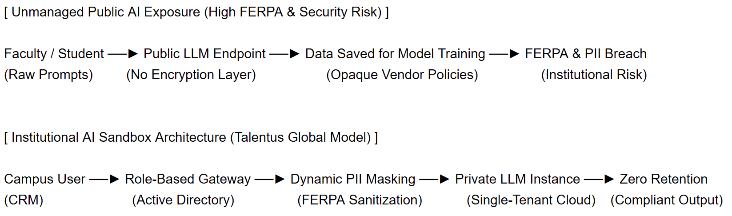
The Operational & Regulatory Risks of Shadow AI
Allowing ungoverned AI usage across campus departments introduces significant regulatory, financial, and reputational liabilities:
- FERPA and PII Violations: Uploading student transcripts, advising notes from Element451, or financial records from Thesis Elements into public LLM interfaces directly violates federal privacy mandates.
- Loss of Intellectual Property: Researchers pasting unreleased grant proposals or patent algorithms into public AI models risk forfeiting IP protections if data is ingested into public training corpora.
- Opaque Data Lineage: Without centralized logging and observability, IT administrators cannot audit model outputs, track hallucination rates, or prevent prompt injection vulnerabilities.
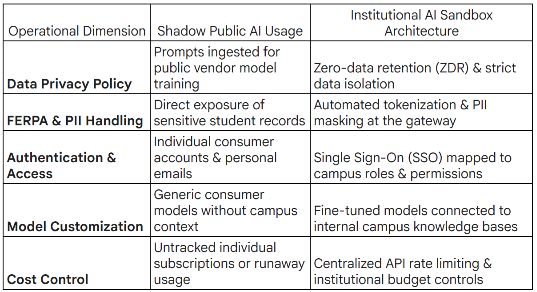
Shadow AI Usage vs. Institutional AI Sandbox Architecture
Transitioning from unmanaged public AI tools to a dedicated institutional sandbox establishes a secure, compliant foundation for campus-wide GenAI adoption:
3 Pillars for Building a Compliant Campus AI Sandbox
Constructing a secure, enterprise-grade AI environment for higher education requires three core architectural guardrails:
1. Zero-Trust API Gateways with Automated PII Masking
Deploy an intelligent proxy gateway between user prompts and underlying foundational models. This layer automatically scans incoming queries for Personally Identifiable Information (PII), such as Social Security numbers, student IDs, and financial records, tokenizing sensitive fields before the payload reaches the LLM.
2. Deep Integration with Campus Platforms via API Middleware
An AI sandbox achieves maximum value when embedded directly into existing workflows. Utilizing EdTech Connectors connects private LLM endpoints safely to a LMS, CRM, and SIS, enabling secure administrative assistance and automated grading support without exposing raw backend databases.
3. Role-Based Governance and Token Rate Limiting
Implement granular controls through your university’s identity management framework (SSO/SAML). Assign customized model access, token quotas, and system prompts based on institutional roles, granting researchers high-parameter models while providing students with targeted, sandboxed tutoring tools.
Build Your Campus AI Infrastructure with Talentus Global
Deploying a private, FERPA-compliant AI environment requires specialized cloud data engineering, DevSecOps expertise, and deep higher education domain experience.
Talentus Global provides dedicated nearshore LATAM software engineering pods to design, construct, and manage your Institutional AI Sandbox.
For over 30 years, Talentus Global has led enterprise digital transformation and Higher Ed technology integration. Our nearshore developers specialize in private LLM deployment (Azure OpenAI, AWS Bedrock, private open-source models), AI security guardrails, and seamless integrations across CRM, LMS, SIS and many more.
Operating 100% synchronously in your US timezone (EST/CST), our pre-vetted LATAM engineering pods deploy in as little as 48 hours to accelerate your institutional AI vision.
- 100% US Timezone Alignment: Collaborate synchronously with senior developers during standard EST/CST working hours.
- Deploy in 48 Hours: Skip months of domestic recruiting and launch specialized AI engineering pods immediately.
- 95% Developer Retention Rate: Protect institutional context and maintain multi-year AI governance stability.
Protect your data and empower your campus with AI. Partner with Talentus Global today.