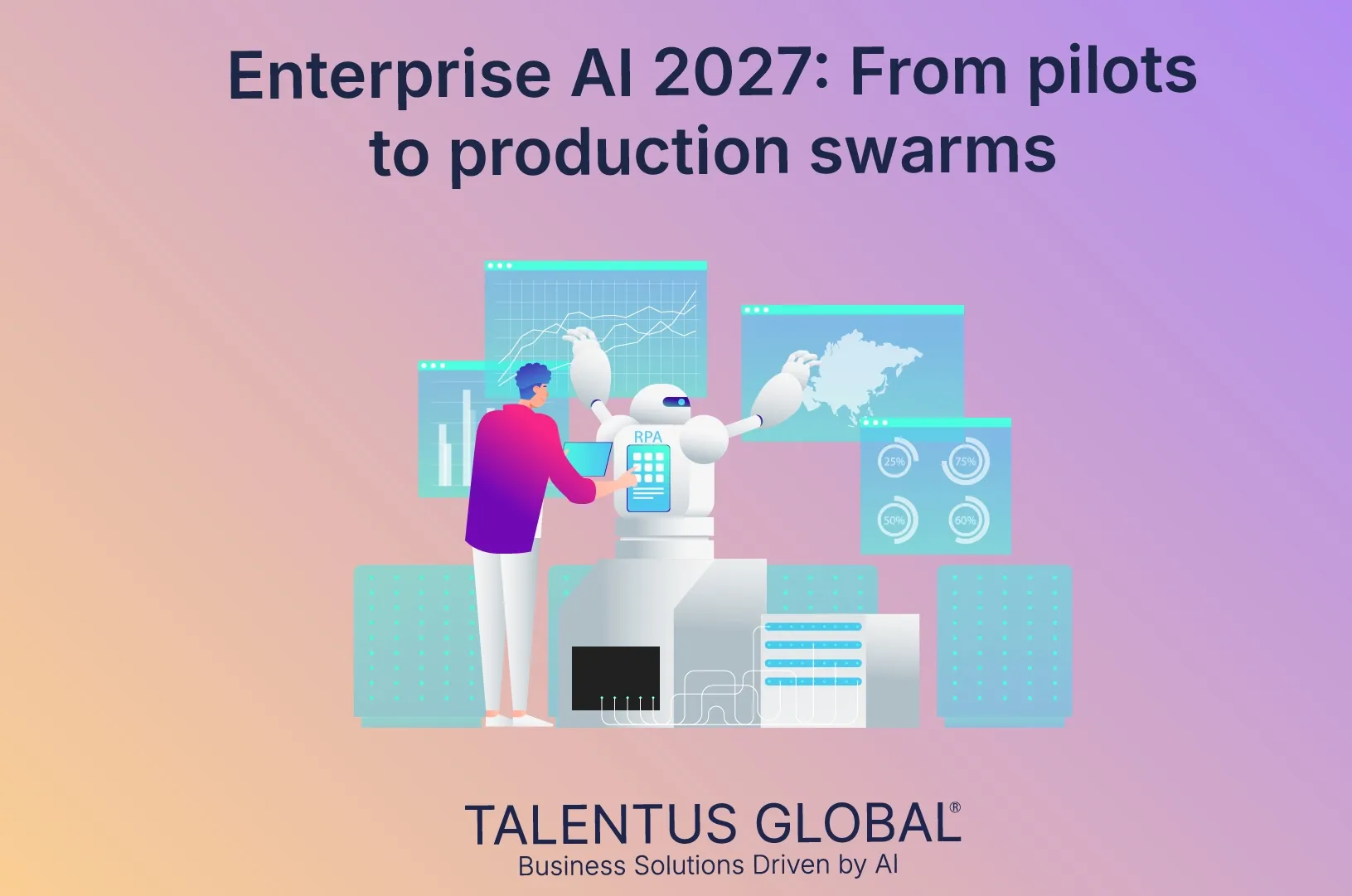
The software engineering landscape is shifting rapidly from single prompt-and-response AI assistants to multi-agent AI networks. In these agentic workflows, autonomous software agents collaborate to write code, execute unit tests, refactor legacy schemas, and attempt automated deployments at machine speed.
While multi-agent systems offer unprecedented engineering velocity, giving autonomous AI agent swarms unmonitored access to production repositories introduces severe architectural risks.
Without strict governance, AI agents can amplify minor hallucinated assumptions into cascading logic failures, introduce security vulnerabilities through unvetted third-party packages, or burn API budgets in infinite execution loops.
Achieving secure, enterprise-grade AI automation requires moving away from pure autonomy toward a governance framework centered on The Human Orchestrator.
The Pitfalls of Unchecked Agent Autonomy
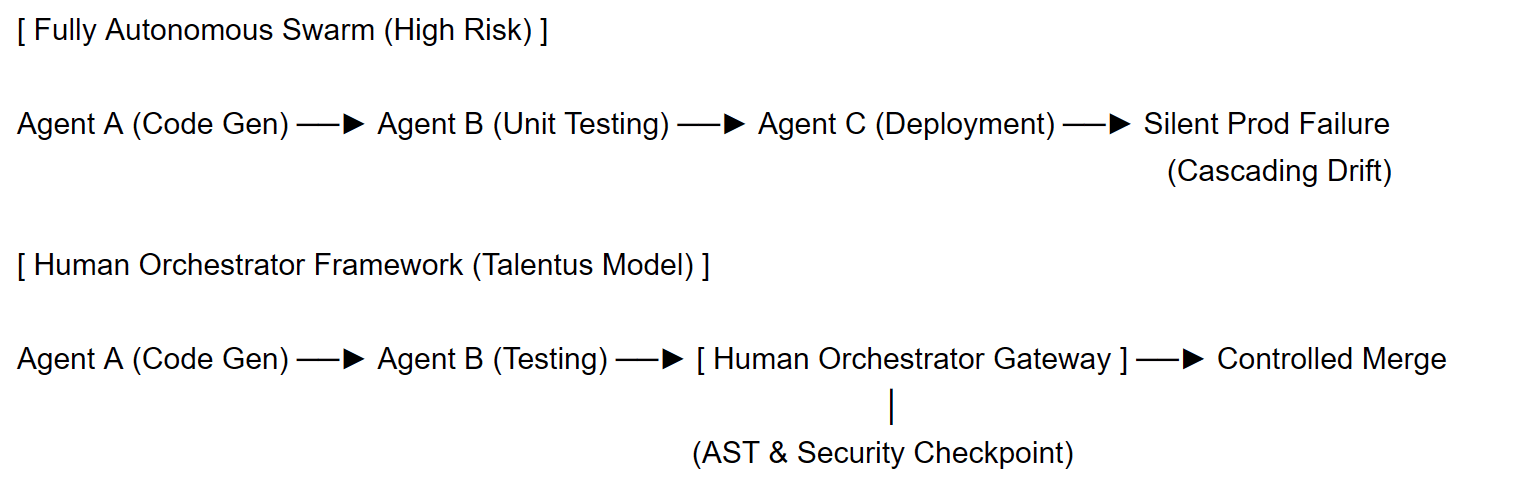
Autonomous agent networks excel at rapid execution within bounded problem spaces. However, when agents pass outputs to other agents without human validation, error rates compound exponentially across the development pipeline.
Key failure modes in unmonitored multi-agent systems include:
- Cascading Hallucinations: If a code-generation agent hallucinates an non-existent internal API parameter, a secondary testing agent may generate tests that validate the broken logic, creating a false positive green build.
- Infinite Recursion Token Loops: When an agent encounters an edge-case build failure it cannot solve, it may repeatedly rewrite and execute the same broken logic loop, consuming thousands of dollars in LLM API tokens within minutes.
- Dependency Hijacking & Security Drift: Autonomous agents tasked with refactoring code often import outdated or unvetted external libraries to solve routine syntax tasks, bypassing Zero-Trust security rules and introducing supply-chain vulnerabilities.
The Human Orchestrator Framework
The Human Orchestrator model does not slow down development; rather, it establishes deterministic guardrails that allow multi-agent networks to operate safely at scale.
Implementing 3 Core Guardrails for AI Networks
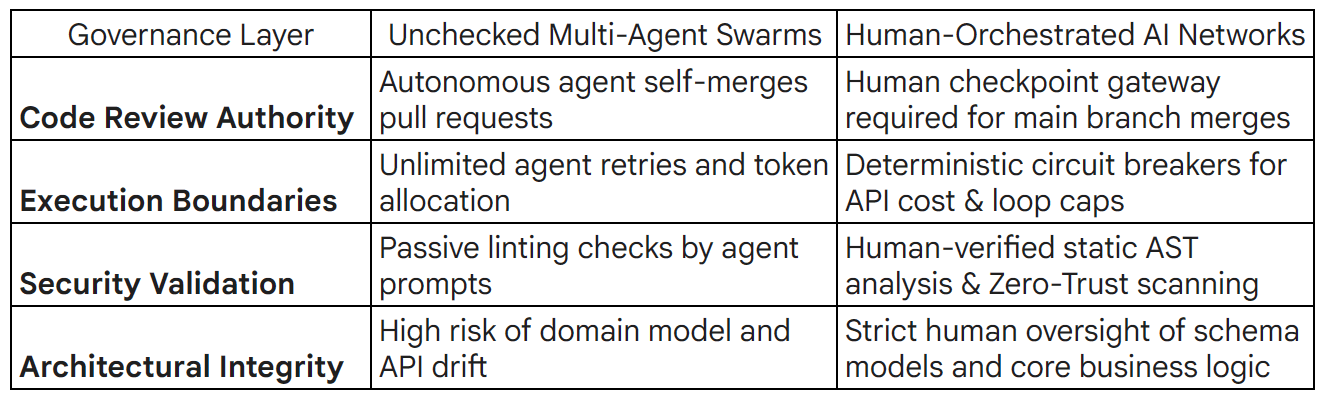
To safely integrate multi-agent networks into production workflows, engineering teams must embed three structural controls:
1. Human Checkpoint Gateways at Branch Boundaries
AI agents should be restricted to isolated feature branches. Moving code from a feature branch to staging or production must require a human engineer to inspect abstract syntax trees (AST), review test coverage, and sign off on pull requests.
2. Deterministic Recursion Circuit Breakers
Set hard operational boundaries within your agent orchestrator framework (such as LangChain or AutoGen). If an agent fails to resolve a test error within three iterations, the circuit breaker trips, halts token consumption, and flags a human developer for intervention.
3. Cognitive Observability Dashboards
Traditional application monitoring tools cannot track agent reasoning. Engineering teams must deploy observability frameworks that log prompt-response chains, trace semantic decision paths, and highlight confidence scores for every AI-generated pull request.
Deploy Human-In-The-Loop AI Engineering with Talentus Global
Building and governing autonomous multi-agent networks requires specialized engineering talent capable of sitting between cutting-edge AI frameworks and enterprise software architecture.
Talentus Global provides the Human Orchestrators your organization needs to scale AI safely.
With over 30 years of enterprise software transformation experience, we deploy dedicated, pre-vetted nearshore LATAM engineering pods specialized in Agentic AI workflows, DevSecOps, and Zero-Trust architecture. Our senior engineers act as expert orchestrators, supervising multi-agent networks, enforcing code quality, and driving engineering velocity without compromising security.
- Synchronous Execution: Our LATAM pods work in your exact US hours (EST/CST), providing real-time code reviews, daily standups, and immediate pull-request supervision.
- Bypass Hiring Friction: Skip 60-day domestic recruitment lags and deploy specialized AI integration teams in days.
- 95% Retention Guarantee: Protect institutional memory throughout your AI transformation with our industry-leading team retention.
Stop guessing whether your AI generated code is production-ready. Safeguard your multi-agent networks with Talentus Global today. Click here and explore all of our options