In university IT departments, deployment day is often met with a collective sense of dread. Pushing an update to the Learning Management System (LMS) or rolling out a new feature in the admissions portal usually means crossing your fingers and hoping a critical integration doesn't break in the process.
This anxiety stems from a reliance on manual Quality Assurance (QA). When human testers must manually click through student portals to verify that an update hasn't corrupted a database or broken a payment gateway, the development lifecycle grinds to a halt. Manual QA is slow, error-prone, and impossible to scale.
As higher education institutions race to deliver seamless, consumer-grade digital experiences, they cannot afford deployment bottlenecks or post-launch rollbacks. To achieve true agility, universities must transition to Continuous Integration and Continuous Deployment (CI/CD) pipelines powered by Automated QA systems.
Overcoming the Manual QA Bottleneck
The traditional "waterfall" approach to software updates isolates testing to the very end of the development cycle. By the time a bug is found, it is expensive and time-consuming to fix.
Automated QA systems flip this paradigm by integrating testing into every stage of the software lifecycle. Using frameworks like Selenium, Cypress, or JUnit, automated scripts run thousands of regression tests, API checks, and performance benchmarks the moment an engineer commits new code.
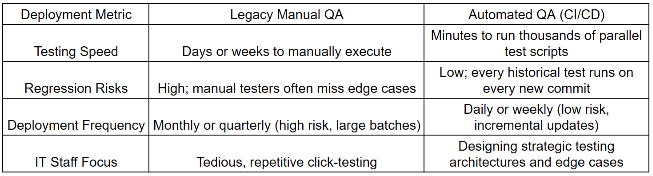
By replacing human repetition with machine precision, Automated QA creates a fail-safe environment. If a new line of code accidentally breaks the API connection between your Student Information System (SIS) and your CRM, the automated pipeline instantly flags the error and halts the deployment before it reaches the live campus environment. This is the secret to continuous safe deployment.
Build Robust CI/CD Pipelines with Talentus Global
Transitioning from a manual testing culture to an automated DevSecOps environment requires a significant initial investment in architectural bandwidth. IT teams must build the CI/CD pipelines, write the initial test scripts, and configure the deployment servers. For university IT departments already drowning in helpdesk tickets, allocating resources to build this infrastructure is nearly impossible. Furthermore, attempting to hire domestic automation engineers typically results in 60-day hiring friction and exorbitant salary demands.
Talentus Global provides the engineering capacity you need to automate.
With over 30 years of experience in higher education digital transformation, we understand the complexities of campus ecosystems. Through our LATAM Global Delivery Centers (Colombia, Peru, Mexico, Argentina), we deploy specialized, pre-vetted nearshore software engineering pods proficient in DevSecOps, Automated QA, and API-first architectures.
Our engineers operate synchronously in your US timezone (EST/CST), allowing them to collaborate seamlessly with your internal developers in real-time. We help you build the CI/CD pipelines and automated testing frameworks required to update your legacy systems safely and continuously. With an industry-leading 95% engineer retention rate, we offer a stable, long-term partnership that eliminates deployment anxiety.
Stop fearing deployment day. Accelerate your digital campus with our EdTech solutions by clicking here