
The contract is signed. Now the real test begins. See how EdTech products earn a place in campus life, from the first pilot to wide adoption, deep SIS and LMS connections and the renewal meeting, and what to measure before that meeting comes.
EdTech product retention in higher education is decided long before the renewal date. Colleges keep the products that become part of how the campus works: connected to the student information system (SIS) and the learning management system (LMS), used beyond the first department, and easy for IT to support. Products that stay on the edge of campus life are the first ones cut when budgets get reviewed.
For EdTech founders, product leaders and CTOs, that changes the job. Winning the contract is the start, not the finish. The real work is turning a pilot into something the institution cannot imagine running without.
Why EdTech product retention is decided in the first semester
The first semester after go-live sets the story that decision-makers will tell at renewal time. Do faculty still log in after week three? Does student data reach the SIS without someone uploading a spreadsheet? Does the help desk get tickets it cannot answer? By the time the renewal meeting starts, most people in the room have already made up their minds.
Budgets make this sharper. The 2026 EDUCAUSE Top 10 includes "Measured Approaches to New Technologies," which asks institutions to audit the tools they already have, consolidate duplicates and require vendors to be open about costs, integrations, interoperability and product roadmaps, even writing those expectations into contracts. A product that cannot show its place in the campus ecosystem is an easy line to remove.
The pressure shows up in vendor numbers too. The 2026 SaaS & AI Performance Benchmarks from Aleph and Benchmarkit put median net revenue retention at 102% and median gross revenue retention at 84% for 2025. For a higher education SaaS company, every lost campus is hard to replace, because sales cycles are long and buying happens on the academic calendar.
The EdTech product journey: pilot, adoption, integration, renewal
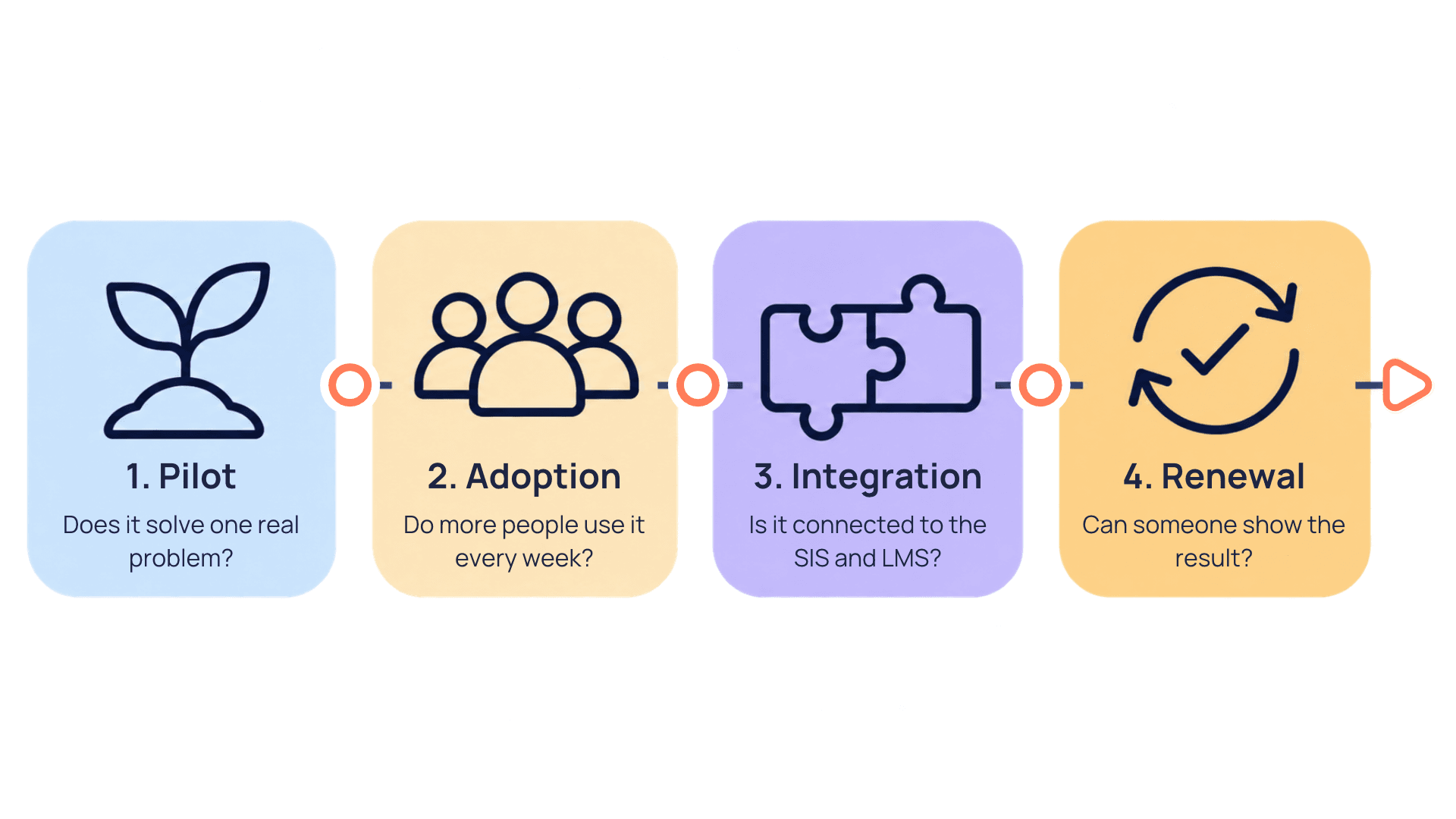
Most products that renew follow the same four stages. Each stage has one question the institution is quietly asking.
Pilot
One department or program tries the product. The question: does it solve one real problem for one team? Keep the scope small, agree on what success looks like before launch, and make sure someone on campus owns the pilot.
Adoption
Use spreads beyond the first champions. The question: do more people use it every week without being told to? Look for repeat use, new departments asking for access and fewer "how do I" tickets over time.
Integration
The product connects to core systems. The question: is it linked to the SIS and LMS so data flows without spreadsheets? This is where many products stall, and where the strongest ones pull ahead.
Renewal
The product is part of how the campus works. The question: can someone show the result? At this point, removing the product would mean changing processes, retraining staff and rebuilding connections.
What makes a platform sticky on campus
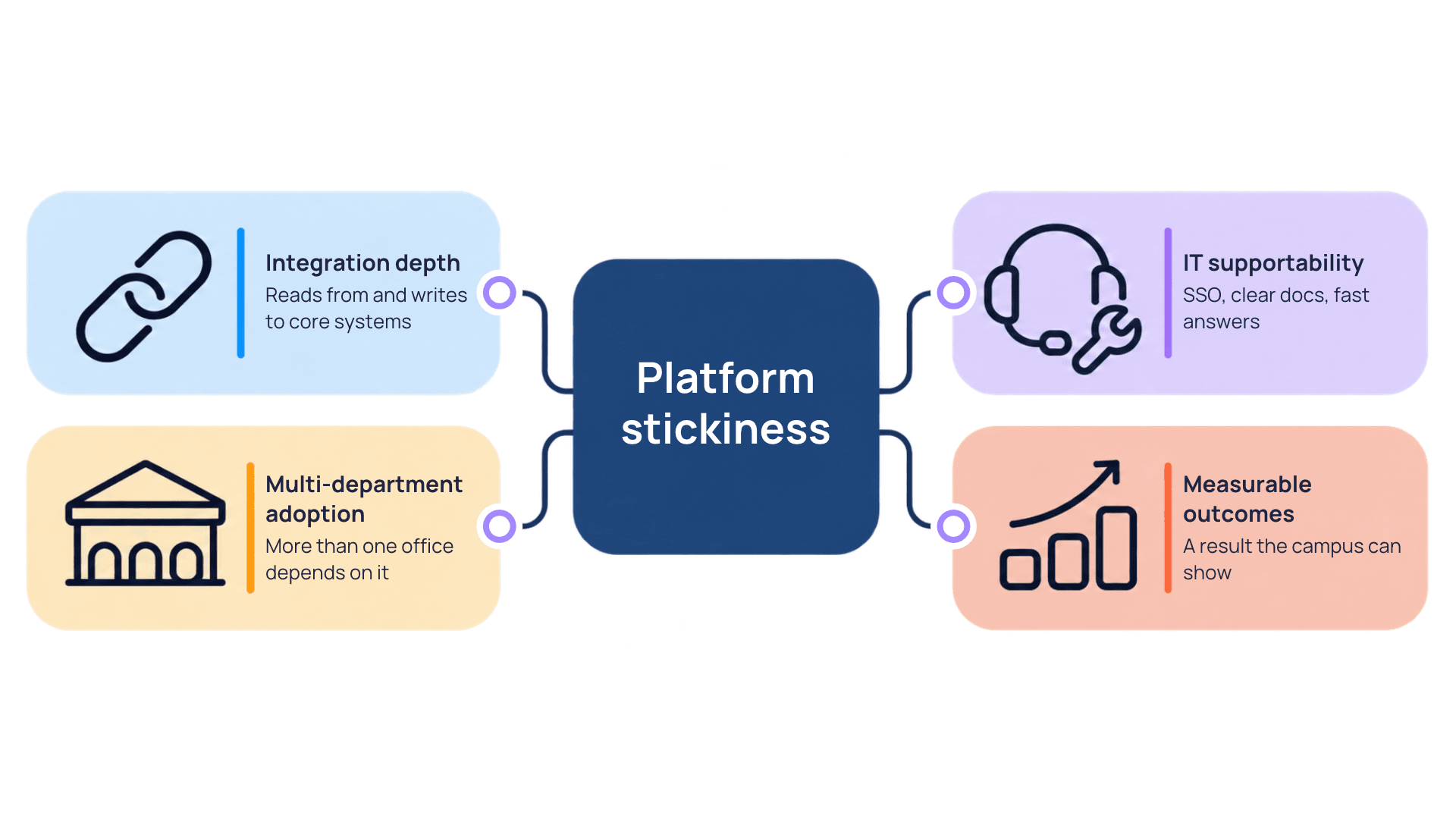
Platform stickiness is not about locking customers in. It is about being so useful and so well connected that replacing you costs more than keeping you. Four drivers matter most:
- Integration depth. The product reads from and writes to the SIS, LMS and other core systems, so it holds current data and other tools depend on it.
- Multi-department adoption. Admissions, the registrar, advising and faculty all use it. When one sponsor leaves, others still need it.
- IT supportability. Single sign-on, clear documentation, predictable updates and fast answers from your support team. IT teams protect the tools that do not create extra work.
- Measurable outcomes. The institution can point to a result it cares about, such as hours saved, faster processes or earlier support for students.
A product strong in only one of these is fragile. A product strong in all four is very hard to replace.
Integrations that IT will thank you for
Good EdTech integrations are the clearest signal that a product respects the campus it serves. Start with open standards from 1EdTech. Learning Tools Interoperability (LTI) connects learning tools to the LMS without separate logins. OneRoster covers rosters and grades, and Edu-API is the emerging standard for exchanging data between higher education administrative systems and teaching and learning tools.
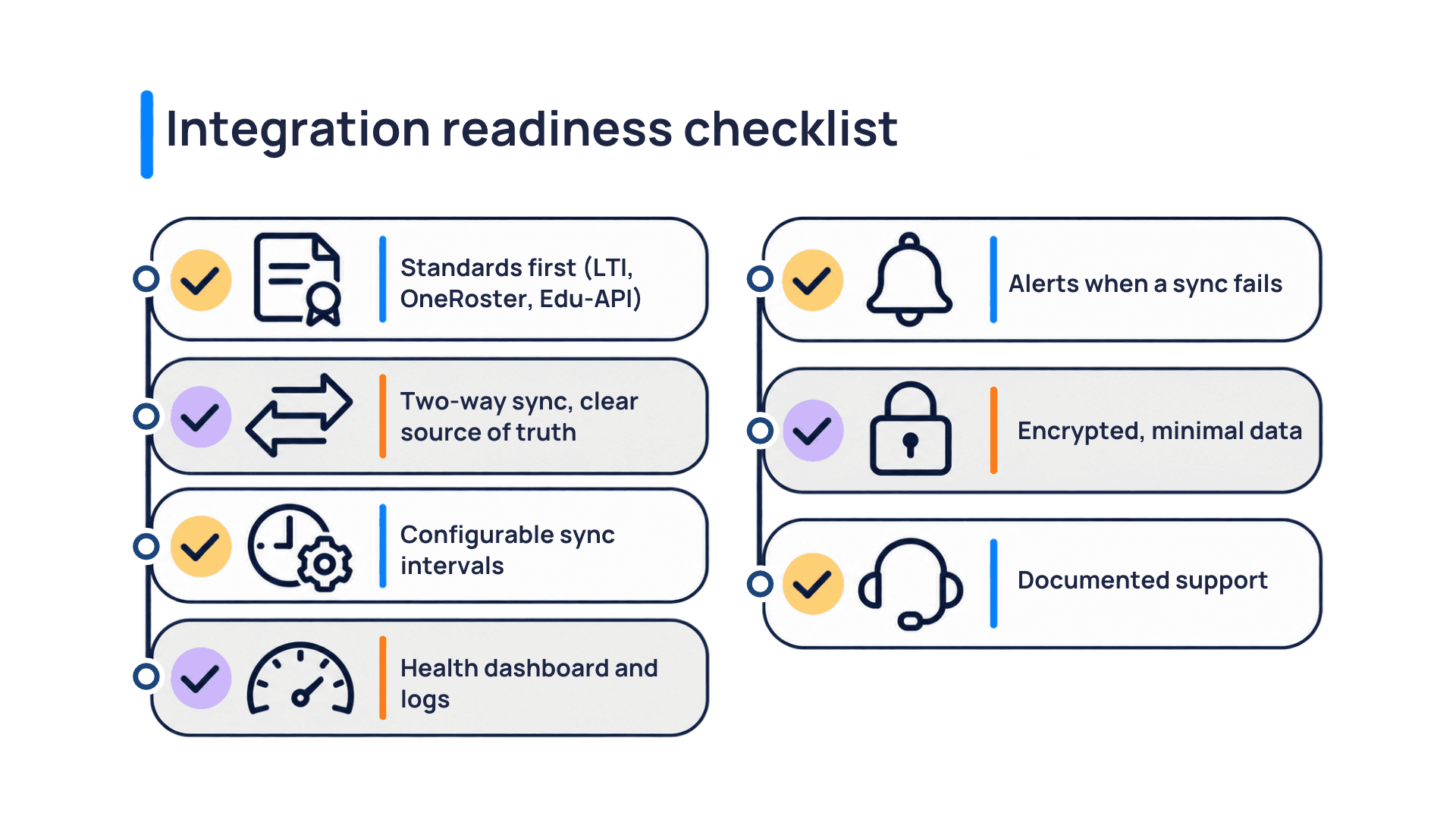
Before you ask a campus IT team to connect your product, check it against this list:
- Standards first. Support LTI and OneRoster where they apply, and follow Edu-API as it matures.
- Two-way sync with a clear source of truth. Define which system owns each field, so records do not overwrite each other.
- Configurable sync. Let administrators set sync intervals instead of hard-coding them.
- Visible health. Give IT a dashboard with sync logs, error logs and status.
- Alerts on failure. Notify the right people when a sync fails, before users notice.
- Security by default. Encrypt credentials, move data over HTTPS and keep only the data you need.
- Documented support. Publish how errors are handled and what support response IT can expect.
You do not have to build every connector from scratch. Talentus Global's Connectors Marketplace offers ready-to-deploy connectors for SIS, LMS, CRM, ERP and financial aid systems, with bidirectional sync and an admin portal where institutions can check connector health, review logs and get alerts. If you are comparing options, our guide to evaluating EdTech connectors walks through the questions to ask.
Building the roadmap with institutions, not just for them
An EdTech product roadmap built only from your own assumptions tends to drift away from what campuses need. The products that renew treat their customers as co-designers.
- Create a small advisory group. Include people from IT, the registrar and at least one academic department, not only your main buyer.
- Share the roadmap openly. Institutions are being told to ask vendors for this, so offering it first builds trust.
- Give integration and admin features real space. Student-facing features win demos. Admin and integration features win renewals.
- Release on the academic calendar. Avoid big changes during registration, the first weeks of term and finals.
- Close the loop. When a customer request ships, tell the people who asked for it.
Partnerships help here as well. An implementation partner that already works inside SIS, LMS and CRM platforms can turn institution requests into connectors, portals and admin tools faster, so your core team stays focused on the product.
How to measure stickiness before the renewal conversation
Do not wait for the renewal notice to find out where you stand. Track these signals every month and review them with your campus sponsor at least one term before renewal:
- Weekly active users by role and department. Growth across roles matters more than total logins.
- Number of departments using the product. One department is a pilot. Three or more is a platform.
- Share of data synced automatically. The less data that moves through manual uploads, the more embedded you are.
- Support tickets per 100 users and time to resolve. Falling numbers show the product is becoming easier to run.
- One agreed outcome metric. Choose it with the institution at the start of the pilot and report on it regularly.
At the company level, track gross revenue retention next to net revenue retention. Expansion can hide churn, and in higher education one lost campus often means lost references across a whole consortium or state system.
FAQ
What is EdTech product retention?
EdTech product retention is how well an education technology company keeps its institutional customers from one contract term to the next. In higher education, it depends less on features and more on fit: how deeply the product is integrated, how many departments use it, how easy it is for IT to support and whether the campus can see clear results.
When should an EdTech vendor start planning for renewal?
On the first day of the pilot. Agree on the success metric before launch, then review usage, integrations and support data with your campus sponsor every term. By the time the renewal notice arrives, the decision should rest on evidence both sides have already seen, not on a last-minute presentation.
Which integrations matter most for colleges?
The SIS and the LMS come first, because they hold student records, rosters, courses and grades. After that, the CRM matters for admissions and advising, the ERP for finance and HR, and financial aid systems for aid packaging. Supporting open standards such as LTI and OneRoster makes each of these connections faster and easier for IT.
How can a small EdTech team support integrations without a large IT staff?
Use ready-made connectors where they exist, focus your engineers on the core product and document every integration clearly. A partner that offers prebuilt connectors and SLA-based support can cover maintenance and monitoring, so your team is not pulled into every sync error and can keep building what customers ask for.
Next step
If renewals feel uncertain, start with your integrations and your roadmap. Talentus Global's EdTech product and integration services help EdTech providers and universities connect core systems, build products and keep them running with SLA-based support. Talk to an EdTech specialist about your integration roadmap.