Traditional offshore outsourcing traded velocity for low hourly rates, forcing engineering leaders to accept 12-hour time gaps, language barriers, and constant rework.
In modern software delivery, that equation has broken down.
With complex cloud-native architectures, continuous integration pipelines, and rapid product release cycles, low hourly rates no longer equate to low project costs. Enterprise technology leaders are shifting from traditional offshore vendor models to Timezone-Aligned Nearshore LATAM Engineering Pods, prioritizing 100% synchronous collaboration, high developer retention, and rapid sprint execution.
The Hidden Total Cost of Ownership (TCO) in Offshore Delivery
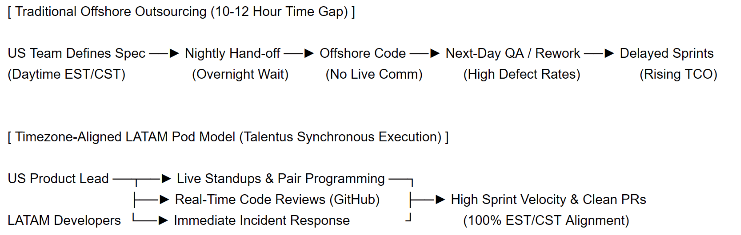
Evaluating software engineering partners purely on initial hourly rates obscures the massive overhead costs generated by asynchronous friction:
- 24-Hour Feedback Loops: A single ambiguous requirement or pull request blocker can stall progress for an entire business day while waiting for overnight time zones to wake up.
- High Developer Attrition: Traditional offshore vendors frequently experience 30% to 40% annual turnover, constantly cycling junior developers onto accounts and forcing client teams to re-train replacement staff.
- Heavy QA and Re-architecting Rework: Code written in isolation without live feedback often fails pull request reviews, requiring duplicate sprint cycles that double the actual cost per feature.
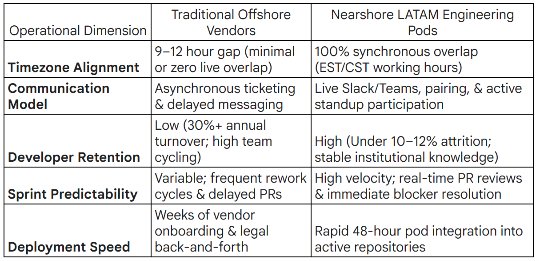
Traditional Offshore Vendors vs. Nearshore LATAM Engineering Pods
Upgrading your global delivery architecture replaces asynchronous hand-offs with synchronous co-development:
3 Pillars of High-Velocity Nearshore Software Delivery
Building a resilient, high-output engineering organization requires three fundamental operational alignments:
1. Complete Timezone Synchronicity (EST/CST)
Eliminate asynchronous bottlenecks by integrating software developers who work during your exact business hours. Live interaction during daily standups, sprint planning, and architecture design reviews allows teams to resolve spec ambiguities instantly and ship production-ready code faster.
2. High Developer Retention and Context Protection
Prioritize team stability over temporary headcount. Dedicated LATAM pods with high retention rates protect deep domain expertise across complex enterprise codebases, eliminating the productivity tax of constantly onboarding new personnel.
3. Integrated Tooling and Cloud-Native Rigor
Ensure remote engineers operate with modern DevOps practices. Nearshore pods seamlessly align with internal CI/CD pipelines, automated testing suites, and code review standards on GitHub/GitLab, functioning as a natural extension of your core engineering team.
Scale Your Engineering Velocity with Talentus Global
Overcoming software backlog and scaling technical capacity requires senior engineering talent aligned directly with your operational rhythm.
Talentus Global provides dedicated nearshore LATAM software engineering pods to build, modernize, and scale your core digital platforms.
For over 30 years, Talentus Global has been a trusted delivery partner in enterprise digital transformation and software engineering. Operating through our LATAM Global Delivery Centers, we assemble pre-vetted engineering pods specialized in cloud-native architectures, API integration layers, full-stack web platforms, and advanced AI implementations.
Our LATAM developers operate 100% synchronously in your US timezone (EST/CST), deploying into your development workflow within 48 hours to accelerate roadmap execution without domestic hiring friction.
- 100% US Timezone Alignment: Collaborate synchronously with senior engineers during standard EST/CST working hours.
- Deploy in 48 Hours: Bypass months of recruiting and launch dedicated, specialized engineering pods immediately.
- 95% Developer Retention Rate: Maintain institutional knowledge and code quality across long-term initiatives.
Eliminate delivery bottlenecks and accelerate your product roadmap. Partner with Talentus Global today by clicking here