
The hourly rate is the least useful number in a nearshore budget. A US engineer's real cost starts with salary and keeps going: benefits, recruiting, equipment, a desk. A LATAM rate usually bundles most of that in. Before you lock your 2027 headcount plan, run the comparison the way your CFO will, and decide now which delivery numbers will prove it worked.
To calculate nearshore software development cost properly, compare the fully loaded cost of a US hire with the all-in rate of a Latin American engineer, not two hourly rates. Then track delivery metrics, so the savings are not lost to slower output. Done this way, a five-person team can cost roughly a third to half less.
The rest of this post shows the math, step by step, with public data you can check.
Why Q4 is when the math matters
Budgets for 2027 are being set now, and headcount decisions made in October decide who is writing code in February. Hiring takes time on both sides. SHRM's 2025 recruiting benchmarks put average time to fill at about a month and a half, before notice periods and onboarding. If a Q1 start matters, the decision belongs in this budget cycle.
It is also when finance asks the hard question: what is the real return? Nearshore ROI only holds up in that meeting if both sides of the comparison use the same definition of cost.
The fully loaded cost of a US engineer
The cost of hiring software engineers in the US starts with salary and keeps going:
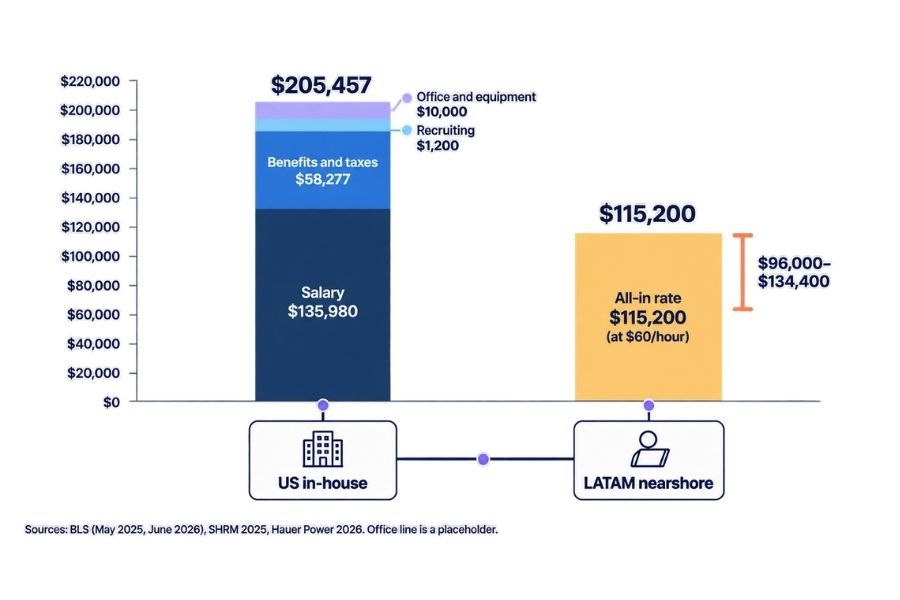
- Salary. The Bureau of Labor Statistics reports a median annual wage of $135,980 for software developers in May 2025.
- Benefits and payroll taxes. In June 2026, benefits made up 30% of private-industry compensation costs, according to the BLS Employer Costs for Employee Compensation release. On a $135,980 salary, that is about $58,277 a year.
- Recruiting. SHRM put the average cost per hire for nonexecutive roles at $1,200 in 2025. Agency fees for engineers are usually far higher, so use your own number.
- Equipment, software and office space. Laptops, licenses, a desk and the people who support them. Use your own figure here too.
Note that the BLS figure is a median across all experience levels. Senior engineers cost more, so a comparison built on the median is conservative.
What a nearshore engineer costs, and what is included
LATAM developer rates vary by country and seniority. Hauer Power's 2026 nearshore rate guide lists fully loaded senior rates of $45 to $60 an hour in Colombia and $50 to $70 in Mexico, against $150 to $250 for onshore US work. Curotec's LATAM rate table, updated in April 2026, puts senior developers in Mexico at $50 to $80 an hour.
Those rates are all-in. They usually cover salary, local benefits and taxes, the provider's overhead and, in some cases, project management time. That is why you compare them with a fully loaded US cost, not with salary alone.
Talentus Global's own figure for nearshore staff augmentation is average savings of $30,000 to $65,000 per hire per year, or 30% to 65% less than US-based engineers, depending on role, country and seniority.
A worked example: nearshore software development cost for a 5-person team
This example uses the public figures above. The office and equipment line is a placeholder of $10,000 per engineer; replace it with your own.
US in-house, per engineer, per year
- Salary: $135,980
- Benefits and payroll taxes (30% of total compensation): $58,277
- Recruiting: $1,200
- Office and equipment (placeholder): $10,000
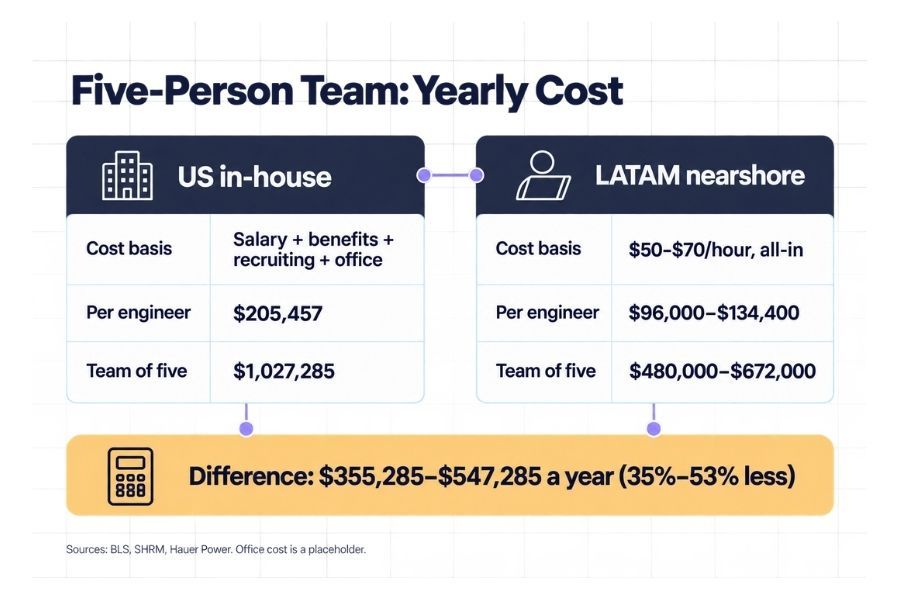
- Fully loaded: $205,457
US team of five, per year
- $1,027,285
Nearshore team of five, per year
- Rate range: $50 to $70 an hour, all-in
- Hours: 160 a month, or 1,920 a year
- Per engineer: $96,000 to $134,400
- Team of five: $480,000 to $672,000
Difference
$355,285 to $547,285 a year, or 35% to 53% less
That range sits inside the one Talentus Global publishes. Your own result depends on the roles you need, so run it for your actual team before it goes into a budget. If you are still deciding how to engage a team, see our comparison of staff augmentation vs managed teams.
Two costs are missing from both columns, and they cut in different directions. Turnover: replacing a US engineer means another search, another ramp-up and lost output, while a provider usually handles replacement. Management time: someone on your side still sets priorities and reviews work, whichever model you choose. Add both to your own version of the math.
Time-zone overlap: the cost nobody puts in the spreadsheet
A lower rate only pays off if the work moves at the same speed. When an engineer works 10 or more hours away, a question asked at 4 p.m. gets answered the next morning. One blocked task becomes a lost day, and lost days add up across a sprint.
Nearshore teams in Latin America work in the same time zone as US teams or within one to two hours of it. They join the same standups, review code the same day and fix production issues while your team is still online. That overlap does not show up in a rate card, but it shows up in delivery.
Metrics to track: lead time, deployment frequency, change failure rate
Savings are only half of nearshore ROI. The other half is output. Use DORA's software delivery metrics as your development velocity metrics, and record a baseline before the new team starts:
- Change lead time: how long a change takes to go from commit to production.
- Deployment frequency: how often you ship.
- Change fail rate: the share of deployments that need immediate fixing.
- Failed deployment recovery time: how fast you recover when a deployment fails.
Finance will want one more number: cost per change shipped. Divide the team's monthly cost by the number of changes it deployed that month. If that figure falls after the switch, you have savings and output on a single line, which is the clearest way to present nearshore ROI at budget review.
Compare the same metrics after one quarter. If lead time and fail rate hold steady while cost drops, the ROI is real. If they get worse, fix onboarding, ownership or overlap before you scale the team.
FAQ
How much does nearshore software development cost?
Senior developers in Latin America typically cost between $45 and $80 an hour on a fully loaded basis, depending on country and source, against $150 to $250 an hour for onshore US rates. Your real figure depends on role, seniority and engagement model, so compare fully loaded costs, not posted rates.
What is included in a fully loaded engineer cost?
Salary, benefits, payroll taxes, recruiting, equipment, software licenses and office space. In the US, benefits alone made up 30% of private-industry compensation costs in June 2026, according to the Bureau of Labor Statistics. Nearshore rates from a provider usually include most of these items, so the two numbers are not comparable at face value.
How long does it take to see ROI from a nearshore team?
Expect a few weeks of onboarding before output is steady. Measure from a baseline: record lead time, deployment frequency and change fail rate before the team starts, then compare after one quarter. The cost savings appear on the first invoice; the delivery gains take longer to show up in the numbers.
Does time-zone overlap really affect cost?
Yes. When a question waits overnight for an answer, a one-hour task can take a full day, and those delays add up across a sprint. Teams in the same or nearly the same time zone clear blockers in real time, which protects lead time and the savings the lower rate was meant to deliver.
Next step
Run the numbers for your own team. Try the Nearshore Calculator to compare more than 50 roles across four seniority levels against US, Canadian or European costs.
Want help building the business case for 2027? Schedule a consultation.