For software executives and product leaders, scaling an engineering department often feels like trying to change a tire while driving down the highway. The engineering backlog never stops growing, customer feature requests continue to pile up, and critical system modernization tasks loom in the background.
To keep pace with demand, the standard corporate playbook dictates opening new developer headcounts.
However, traditional recruitment practices introduce massive, systemic friction. Sifting through hundreds of unqualified resumes, coordinating endless rounds of technical screening, and navigating intense domestic salary bidding wars typically results in a 45-to-60-day lag before a candidate is ever onboarded. By the time an engineer is hired, oriented, and context-ready, your product roadmap has completely shifted.
To protect product velocity and bypass this talent bottleneck, modern tech organizations are moving away from traditional fragmented hiring. Instead, they are utilizing pre-vetted nearshore engineering pods to gain high-velocity development pipelines instantly.
1. The Core Anatomy of an Engineering Pod
A common mistake when scaling a development team is adding isolated, disconnected developers to a project. Individual hires require extensive individual management, separate onboarding streams, and a long ramp-up period to find cultural and technical alignment.
A high-velocity Engineering Pod, by contrast, is a self-contained, cross-functional unit designed to take complete ownership of a product feature, module, or technical goal.
Individual Sourcing: Developer A + [Developer B + QA Hire ──> Extreme Onboarding Friction
The Pod Ecosystem: Full-Stack Devs + QA + DevOps Lead ──> Unified 48-Hour Sprint Integration
A fully optimized software pod typically features a balanced mix of specialized roles:
Senior Full-Stack Developers: To handle everything from database schema design to frontend UI/UX deployment.
Dedicated QA Automation Engineers: To build continuous, automated testing scripts directly into the sprint lifecycle, catching regression bugs before production merges.
DevOps/Cloud Specialists: To manage CI/CD pipelines, containerized microservices, and environment architecture.
Instead of a loose group of contractors, a pod functions as a synchronized execution engine that manages its own delivery velocity under your technical direction.
2. Eliminating the Sourcing & Screening Bottlenecks
Assembling a cohesive engineering unit entirely from scratch through traditional corporate pipelines creates administrative and technical friction at every phase of the hiring funnel:
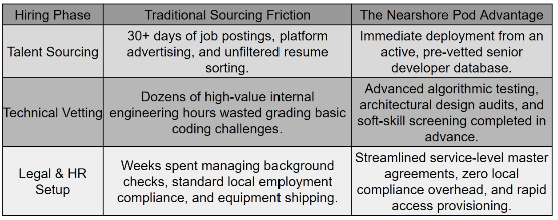
By working with a talent infrastructure partner, technology leaders can compress this multi-month administrative sprint down to under 48 hours, moving directly from role selection to active sprint participation.
3. Achieving True Synchronous Collaboration
Active LATAM Network ──> Timezone-Aligned Sync ──> High-Velocity Code Delivery
Eliminating hiring friction is meaningless if your newly deployed development team operates in a radically different time zone. Traditional offshore models often introduce an "asynchronous latency tax," where internal leads must wait 12 hours just to get a question answered or review a pull request.
The Talentus Velocity: At Talentus Global, we solve both the hiring friction and communication bottlenecks by providing synchronized nearshore engineering pods based in Latin America. Our senior tech talent operates in your exact working hours (EST/CST), enabling real-time collaboration, instant Slack or Teams communication, and seamless participation in morning Agile standups.
Through our specialized systems division Marketplace, we supply the top 5% of pre-vetted LATAM engineering talent, fully bilingual, highly collaborative, and ready to plug directly into your technical architecture.
Stop fighting the domestic talent shortage and losing valuable time to administrative friction. Visit our Marketplace today, click "Select Role," and assemble your high-velocity nearshore engineering pod in under 48 hours.