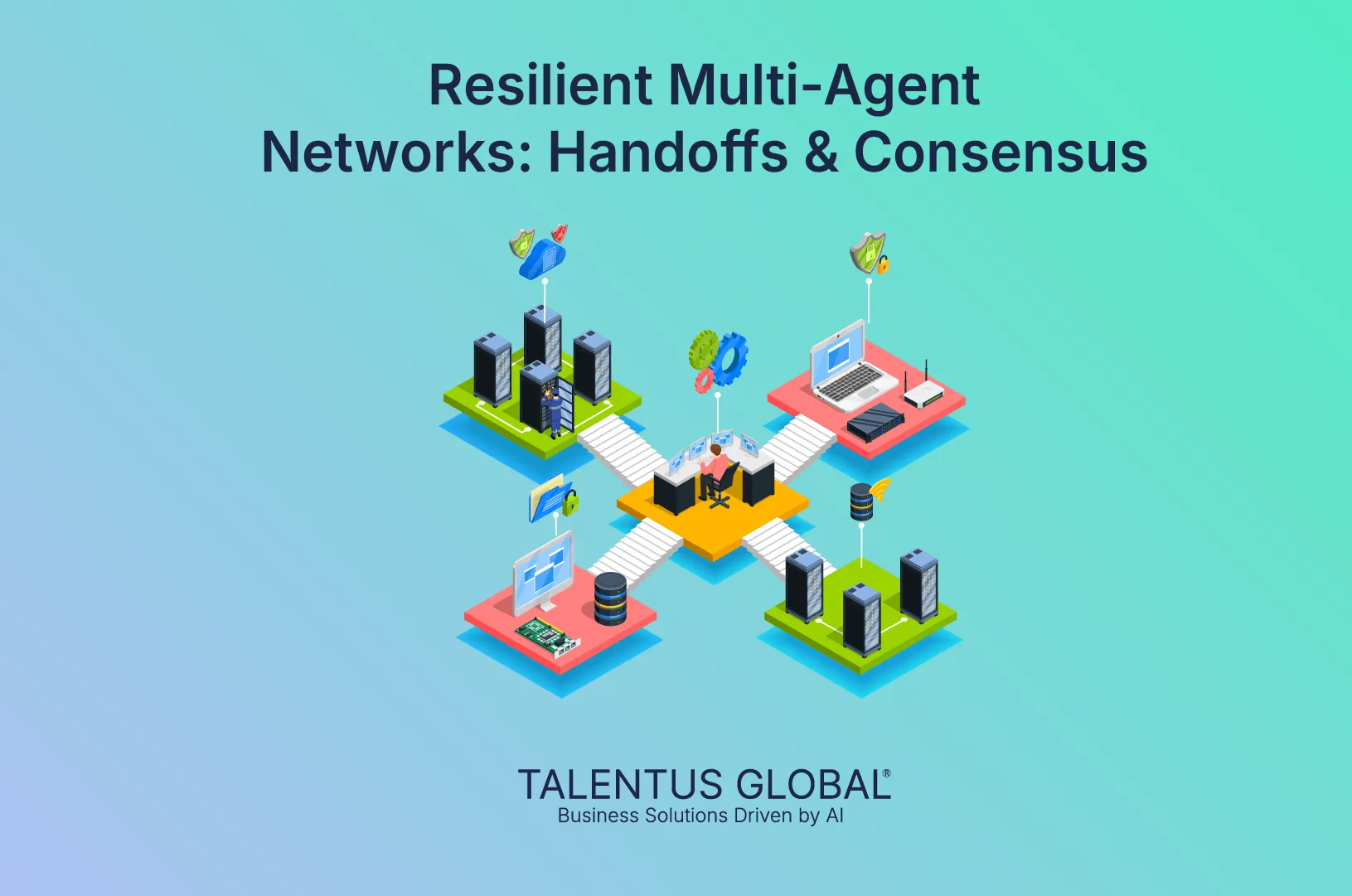
As enterprise AI systems evolve beyond standalone chatbots into multi-agent networks, software teams face a new engineering challenge: managing inter-agent state transitions and consensus
When specialized LLM agents, such as data extractors, code generators, and security verifiers, collaborate to solve complex workflows, the handoff between agents is often where systems break.
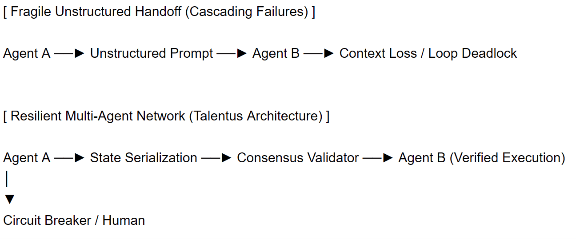
Unstructured agent handoffs suffer from context degradation, non-deterministic state drift, and recursive execution loops. Without formal handoff protocols and consensus mechanisms, multi-agent networks fail quietly in production, producing corrupted state transitions and unrecoverable deadlocks.
Building resilient multi-agent networks requires treating agent-to-agent communication as a distributed system: enforcing typed state schemas, implementing consensus validation nodes, and embedding circuit breakers for fault-tolerant execution.
The Hidden Fragility of Unstructured Multi-Agent Networks
Deploying multi-agent workflows without structured orchestration creates critical failure points across complex execution graphs:
- Context Degradation & Information Decay: As context is passed sequentially through multiple agents, nuanced constraints, system prompts, and edge-case parameters are lost or hallucinated away.
- Recursive Deadlocks & Infinite Execution Loops: When two or more agents disagree on a task outcome, they can enter non-deterministic execution loops, continuously re-evaluating inputs and inflating cloud API costs.
- State Drift Across Distributed Nodes: Without a single source of truth for execution state, individual agents operate on conflicting assumptions, leading to inconsistent outputs across enterprise pipelines.
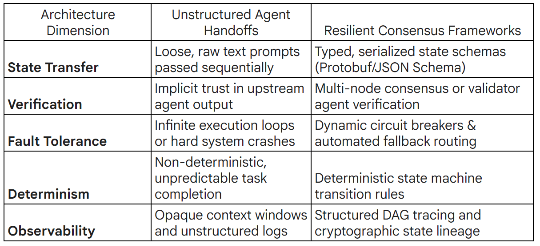
Unstructured Handoffs vs. Resilient Consensus Frameworks
Upgrading multi-agent communication protocols transforms brittle AI experiments into reliable enterprise infrastructure:
3 Pillars of Resilient Multi-Agent Orchestration
Constructing a production-grade multi-agent network relies on three core architectural principles:
1. Strongly-Typed State Handoff Protocols
Eliminate raw natural language handoffs between agents. Enforce explicit, strongly-typed state contracts using JSON Schema or Protocol Buffers. Every agent must receive a verified input payload and emit a structured output state, ensuring downstream agents receive clean, deterministic context.
2. Distributed Consensus & Verification Nodes
Never allow a single agent to unilaterally approve critical state transitions. Implement consensus mechanisms, such as majority voting algorithms, critic-agent verification loops, or deterministic rule engines, to validate agent outputs before committing changes to core databases or external APIs.
3. Dynamic Circuit Breakers & Human-in-the-Loop Fallbacks
Guard against infinite execution loops and cascading hallucinations. Implement circuit breaker patterns that track recursion depth, token consumption, and state delta velocity. If an agent network fails to reach consensus within defined thresholds, automatically route the task to a human orchestrator or a deterministic fallback script.
Accelerate Your AI Architecture with Talentus Global
Architecting resilient multi-agent networks, state machines, and consensus protocols requires senior AI system engineers, cloud architects, and distributed systems specialists.
Talentus Global provides dedicated nearshore LATAM software engineering pods to design, implement, and scale your autonomous AI infrastructure.
For over 30 years, Talentus Global has been a trusted technical partner in enterprise software engineering, cloud architecture, and AI systems development. Our nearshore LATAM developers specialize in multi-agent orchestration frameworks (LangGraph, AutoGen, CrewAI), distributed state management, API middleware, and MLOps telemetry.
- Operating 100% synchronously in your US timezone (EST/CST), our pre-vetted LATAM engineering pods deploy in as little as 48 hours to accelerate your AI engineering roadmap without domestic hiring friction.
- 100% US Timezone Alignment: Collaborate synchronously with senior developers during standard EST/CST working hours.
- Deploy in 48 Hours: Bypass domestic recruitment delays and launch specialized AI engineering pods immediately.
- 95% Developer Retention Rate: Retain deep institutional knowledge and codebase stability across long-term AI initiatives.
Build resilient multi-agent systems with confidence. Partner with Talentus Global today and explore our AI options here.