In fast-moving software markets, spending 60 to 90 days sourcing, interviewing, and onboarding senior software engineers directly stalls product roadmaps and burns capital. Deploying pre-vetted, dedicated nearshore LATAM engineering pods allows enterprise tech leaders to bypass recruitment friction and scale engineering capacity in as little as 48 hours.
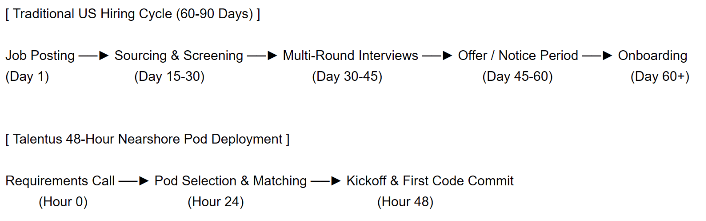
The Hidden Costs of Tech Recruitment Friction
Relying solely on traditional domestic hiring pipelines exposes technology organizations to severe operational liabilities:
- Delayed Product Launch Dates: Every week a senior engineering seat remains vacant, sprint velocity drops, allowing competitors to capture market share.
- Engineering Team Burnout: Existing developers are forced to absorb open headcount workloads, leading to fatigue, lower code quality, and voluntary turnover.
- Exorbitant Placement Fees: US recruitment agencies routinely charge 20% to 30% of first-year salaries without guaranteeing long-term developer retention or cultural fit.
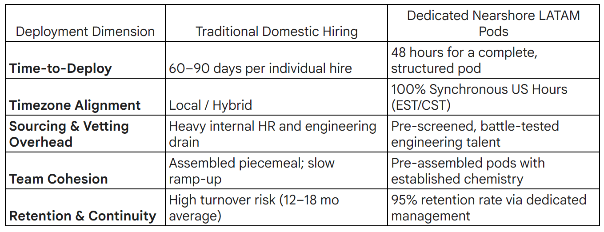
Traditional US Hiring vs. Dedicated Nearshore LATAM Pods
Replacing slow, piecemeal recruitment with cohesive nearshore pods transforms engineering throughput:
3 Pillars of 48-Hour Nearshore Pod Deployment
Deploying high-performing nearshore teams in 48 hours relies on three structural advantages:
1. Pre-Vetted, Pre-Assembled Team Chemistry
Instead of hiring individual freelancers who must learn to work together from scratch, nearshore LATAM pods arrive as cohesive engineering units. They bring established communication patterns, shared agile practices, and proven experience working together across modern stack architectures.
2. Real-Time Synchronous Collaboration (EST/CST)
Unlike offshore teams in distant timezones that cause 12-hour communication delays and midnight meetings, LATAM software engineers operate during your exact business hours. This enables real-time daily standups, instant Slack collaboration, and continuous pair programming.
3. Turnkey Integration & Immediate Velocity
Nearshore engineering pods plug directly into your established repositories (GitHub, GitLab), project management boards (Jira, Linear), and CI/CD pipelines. With administrative friction eliminated, developers begin reviewing pull requests and committing code on day one.
Eliminate Hiring Delays with Talentus Global
Scaling your engineering capacity shouldn't require quarter-long recruiting cycles or sacrificing code quality.
Talentus Global delivers pre-vetted nearshore LATAM engineering pods ready to deploy in 48 hours.
With over 30 years of enterprise digital transformation leadership, Talentus Global provides dedicated software engineering pods specialized in full-stack development, cloud data engineering, API middleware, and AI/LLOps architectures.
Our nearshore teams integrate directly into your internal workflows, operating as a seamless extension of your engineering department while maintaining strict quality standards and zero-trust security compliance.
- 100% US Timezone Alignment: Work synchronously with senior LATAM developers during your standard EST/CST working hours.
- Bypass Recruitment Lags: Skip 60-day hiring cycles and launch fully managed engineering pods in under 48 hours.
- 95% Retention Rate: Maintain institutional knowledge and architectural stability with industry-leading developer continuity.
Stop waiting months to scale your tech stack. Deploy dedicated nearshore LATAM pods with Talentus Global today by clicking here