As higher education institutions scale their analytics infrastructure, Chief Information Officers and Chief Data Officers face a delicate balancing act: empowering leadership with predictive insights while safeguarding sensitive student and institutional data.
Modern campuses process millions of telemetry data points daily across Learning Management Systems (Canvas, Blackboard), Student Information Systems (Banner, Workday), and Admissions CRMs (Slate). While this data fuels early retention alerts and financial forecasting, it also contains sensitive Personally Identifiable Information (PII), academic records, and financial aid details governed by strict regulations like FERPA, GDPR, and evolving state-level data privacy mandates.
Without robust, enterprise-grade data governance, universities risk severe regulatory penalties, data breaches, and compromised student trust.
To capitalize on predictive intelligence without compromising privacy, higher education leaders must implement a governed EdTech analytics framework built on privacy-by-design principles.
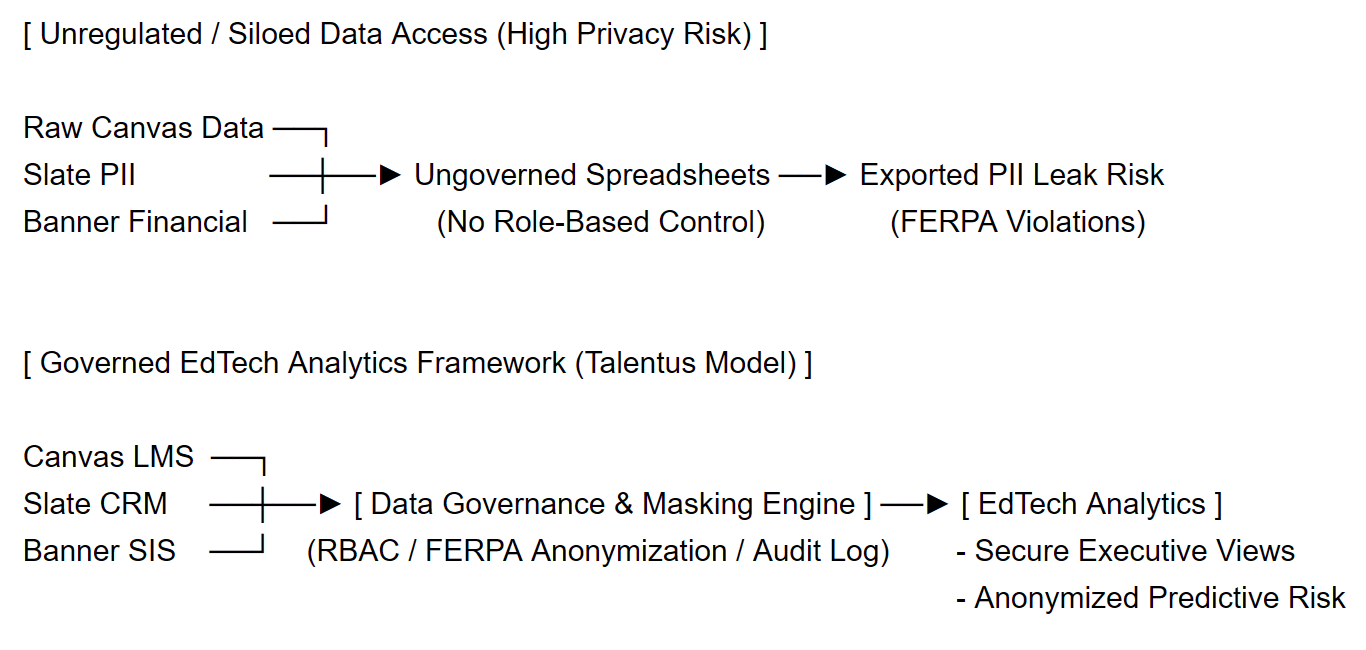
The Hazards of Ad-Hoc Campus Data Pipelines
Deploying analytics dashboards without central data governance introduces major security vulnerabilities across the institution:
- Unchecked PII Exposure: Exporting raw student logs into unencrypted spreadsheets or third-party BI tools exposes sensitive student attributes to unauthorized internal and external parties.
- Over-Privileged User Access: Giving academic advisors or departmental staff unrestricted database permissions allows broad visibility into confidential financial or health data far beyond their operational need.
- Regulatory Non-Compliance: Lacking automated audit logging makes it virtually impossible to prove compliance with FERPA mandates during regulatory reviews or data subject access requests.
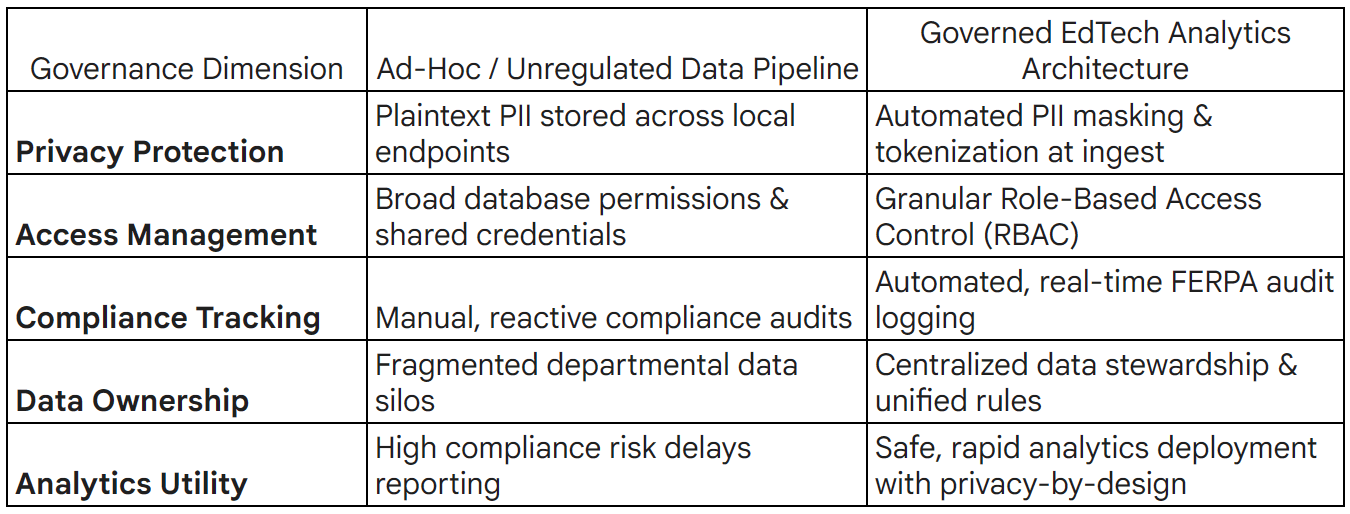
Unregulated Pipelines vs. Governed EdTech Analytics
Establishing a governed data architecture ensures that data utility and data privacy reinforce, rather than oppose, one another:
3 Core Pillars of Governed Campus Analytics
Protecting privacy while extracting predictive value requires three foundational governance controls within your data pipeline:
1. Dynamic PII Masking and Tokenization
Before raw LMS or SIS data enters your central analytics warehouse, automated integration pipelines sanitize or tokenize sensitive fields (e.g., Social Security Numbers, phone numbers, home addresses). Predictive machine learning models train on anonymized behavioral patterns, ensuring data science teams work with zero exposure to raw PII.
2. Granular Role-Based Access Control (RBAC)
With EdTech Analytics, data visibility is automatically scoped by user role. A university president views aggregated, system-wide retention trends; a dean sees department-level cohorts; and an advisor accesses named records only for assigned advisees.
3. Continuous Audit Telemetry & Governance Logs
Enterprise integration middleware logs every data query, export, and API transaction. Automated telemetry continuously monitors access patterns for anomalous behavior, ensuring complete auditability for institutional compliance officers.
Secure Your Campus Data Mesh with Talentus Global
Building a FERPA-compliant, governed data architecture requires specialized software engineering depth across cloud security, API middleware, and data pipeline design.
Talentus Global provides the engineering expertise to secure and modernize your institutional analytics.
For over 30 years, Talentus Global has been a trusted technology partner in Higher Ed digital transformation. Through our nearshore LATAM Global Delivery Centers, we deploy pre-vetted software engineering pods skilled in zero-trust architecture, cloud data warehousing, and enterprise system integration.
Using our pre-built EdTech Connectors and EdTech Analytics framework, we help university IT leaders build secure, privacy-first data streams between Canvas, Slate, Banner, and Workday without custom security flaws or internal resource constraints.
- 100% US Timezone Synchronization: Our LATAM developers operate synchronously during your business hours (EST/CST), collaborating directly with your security and data governance teams.
- Rapid Team Deployment: Skip 60-day recruitment cycles and deploy specialized data security engineering pods in under 48 hours.
- 95% Retention Guarantee: Maintain institutional memory and long-term architectural stability across your compliance roadmap.
Protect student privacy while unlocking actionable intelligence. Explore EdTech Analytics and partner with Talentus Global today.