Software engineering has crossed a fundamental threshold. For decades, applications executed deterministically: given input X and state Y, the application reliably produced output Z.
Debugging was a straightforward exercise in tracing stack traces, reading step-by-step logs, and monitoring CPU, memory, and API response status codes.
Today, enterprise architectures increasingly rely on non-deterministic, probabilistic execution engines, powered by Large Language Models (LLMs), autonomous AI agents, and stochastic decision pipelines. In this paradigm, identical inputs can yield wildly different execution paths, tool calls, and outputs.
When an AI agent fails, it rarely throws a 500 Internal Server Error or a standard null pointer exception. Instead, it returns a 200 OK HTTP status code accompanied by a confident, syntactically valid, but logically hallucinated or instruction-divergent payload.
Legacy Application Performance Monitoring (APM) tools were built to measure system infrastructure, not cognitive intent. Debugging non-deterministic software requires a new operational framework: Cognitive Observability.
[ Legacy APM Stack (Infrastructure & Deterministic Telemetry) ]

  HTTP Requests ──► CPU / Memory Metrics ──► DB Query Latency ──► Stack Trace Logs
  (Sees '200 OK' | Misses Semantic Hallucinations & Infinite Agent Loops)


[ Cognitive Observability Pipeline (Semantic & Agentic Tracing) ]

  Prompt & Context State ──► Reasoning Chain (DAG) ──► Tool Call Intercept ──► Output Eval
                           │
                           ▼
  Real-Time Semantic Drift Detection, Token Cost Tracking, & Faithfulness Scoring
The Flaws of Applying Legacy APM to Stochastic Code
Attempting to monitor LLM pipelines and autonomous agents using traditional metrics creates critical operational blind spots:
- Silent Semantic Failures (200 OK Hallucinations): Legacy APM flags server crashes or high latency. It cannot detect when an agent misunderstands a prompt, outputs incorrect financial advice, or hallucinates non-existent API parameters while returning a clean status code.
- Agentic Reasoning Loops: Autonomous agents using ReAct or Tree-of-Thought patterns can get trapped in recursive self-correction loops. Legacy APM sees normal CPU usage and steady HTTP traffic, masking the fact that the agent is burning thousands of operational tokens on a single request.
- Context Window Memory Leaks: In long-running conversational workflows, performance degrades as relevant context gets pushed out of the model's context window. Traditional APMs monitor application RAM, which remains constant, while the AI's functional "working memory" decays silently.
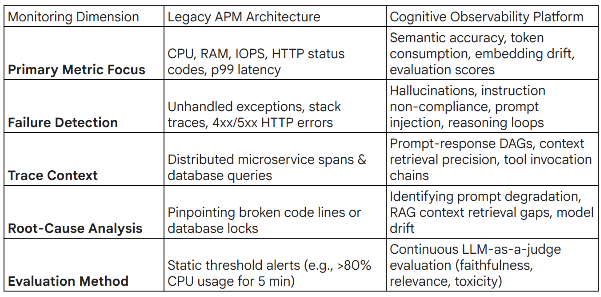
Legacy APM vs. Cognitive Observability
Upgrading from infrastructure monitoring to cognitive observability transforms how engineering teams debug, evaluate, and scale probabilistic software:
3 Pillars of Cognitive Observability Architecture
Building a production-ready observability pipeline for non-deterministic code relies on three specialized engineering layers:
1. Semantic Tracing & Execution DAGs
Instead of recording raw database calls, capture the entire decision graph of the non-deterministic system. Log system prompts, context payloads, temperature parameters, intermediate reasoning steps (thoughts), and raw model outputs as connected Directed Acyclic Graphs (DAGs). This allows developers to step backward through an agent's reasoning chain to isolate exactly where logic diverged.
2. Retrieval & Context Precision Metrics (RAG Triad)
For Retrieval-Augmented Generation (RAG) systems, continuously measure the three core dimensions of context health in production:
- Context Relevance: Did the vector database retrieve records that actually pertain to the user query?
- Groundedness/Faithfulness: Is the generated response derived strictly from the retrieved context, or did the model fabricate facts?
- Answer Relevance: Did the final response directly address the user's original intent?
3. Real-Time Guardrail Interception & Token Throttling
Deploy middleware proxies that evaluate model outputs before they reach the client application. If an agent enters a repetitive execution loop or returns a low-confidence score, the guardrail layer intercepts the request, falls back to a deterministic path, and throttles token consumption, preventing run-away API costs.
Master Non-Deterministic Software Engineering with Talentus Global
Building, debugging, and scaling production AI systems requires senior software architects, MLOps engineers, and telemetry experts who understand the nuances of non-deterministic code.
Talentus Global provides dedicated nearshore LATAM software engineering pods to design, implement, and maintain advanced Cognitive Observability and MLOps architectures.
For over 30 years, Talentus Global has been a trusted technical partner in enterprise software engineering, cloud architecture, and digital transformation. Our nearshore LATAM development teams specialize in LLMOps telemetry, vector database optimization, custom API middleware, and enterprise AI agent orchestration.
Operating 100% synchronously in your US timezone (EST/CST), our pre-vetted LATAM engineering pods deploy in as little as 48 hours to accelerate your AI engineering roadmap without communication or timezone delays.
- 100% US Timezone Alignment: Collaborate synchronously with senior software developers during standard EST/CST working hours.
- Deploy in 48 Hours: Bypass domestic recruiting friction and launch specialized MLOps and integration pods immediately.
- 95% Developer Retention Rate: Retain deep technical expertise and codebase stability across long-term enterprise AI deployments.
Gain full visibility into your AI applications. Partner with Talentus Global today.