In today’s digital campus, speed is no longer just a technical convenience, it is directly tied to student success and operational stability.
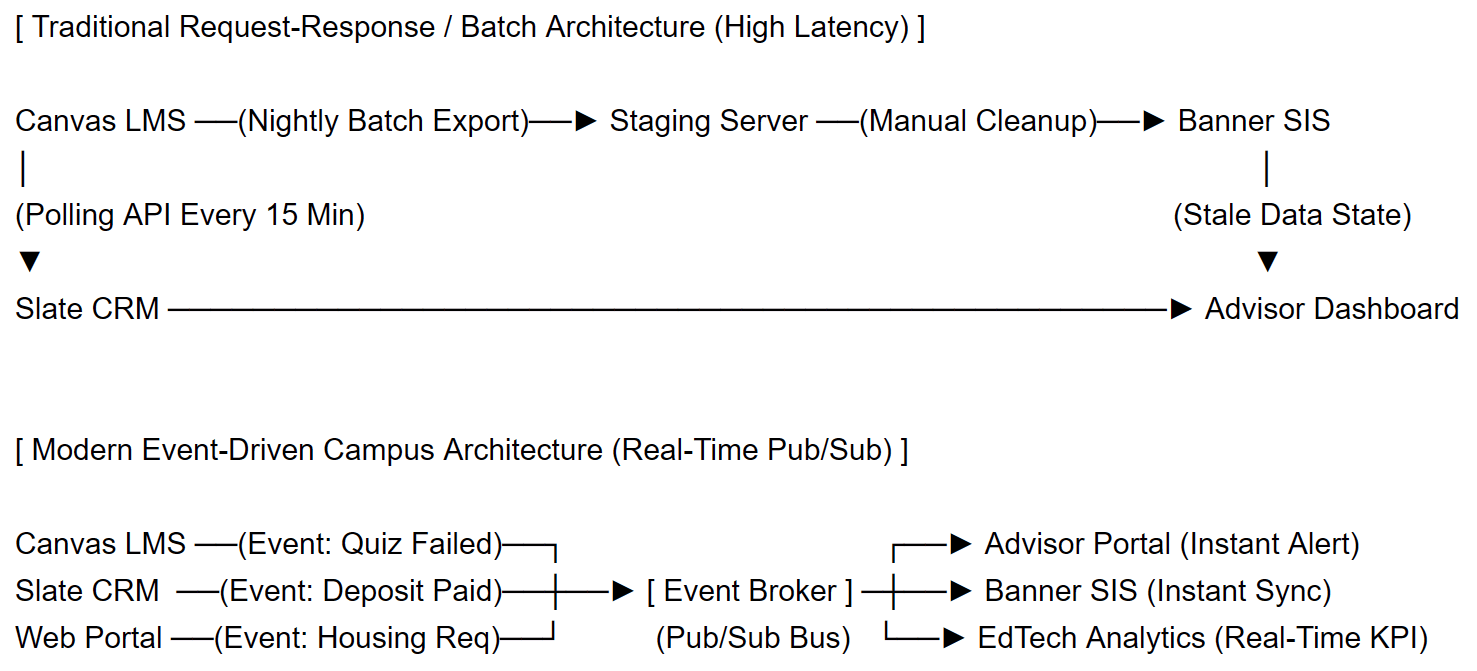
When a student drops below an engagement threshold in a Learning Management System (LMS) like Canvas, an academic advisor needs to know immediately, not three days later after a scheduled batch process runs. When a prospective student submits a deposit through an admissions portal like Slate, their registration hold should clear instantly in the Student Information System (SIS) like Banner or Workday, rather than waiting for an overnight Cron job.
Despite these real-time operational demands, many higher education IT ecosystems remain tethered to legacy batch processing and periodic polling API calls.
When every platform continuously polls every other platform for updates, network overhead spikes, API rate limits are exceeded during peak enrollment windows, and data latency cripples campus decision-making.
To achieve true operational responsiveness, university CIOs and enterprise architects must shift from point-to-point batch transfers to a modern Event-Driven Campus Architecture (EDA).
The Limitations of Polling and Batch Data Transfers
For decades, higher ed system integrations relied on two primary patterns: nightly file transfers (CSV exports) or recurring API polling (e.g., querying an endpoint every 10 minutes to check if a record changed).
While easy to implement initially, polling and batch models introduce severe architectural flaws at scale:
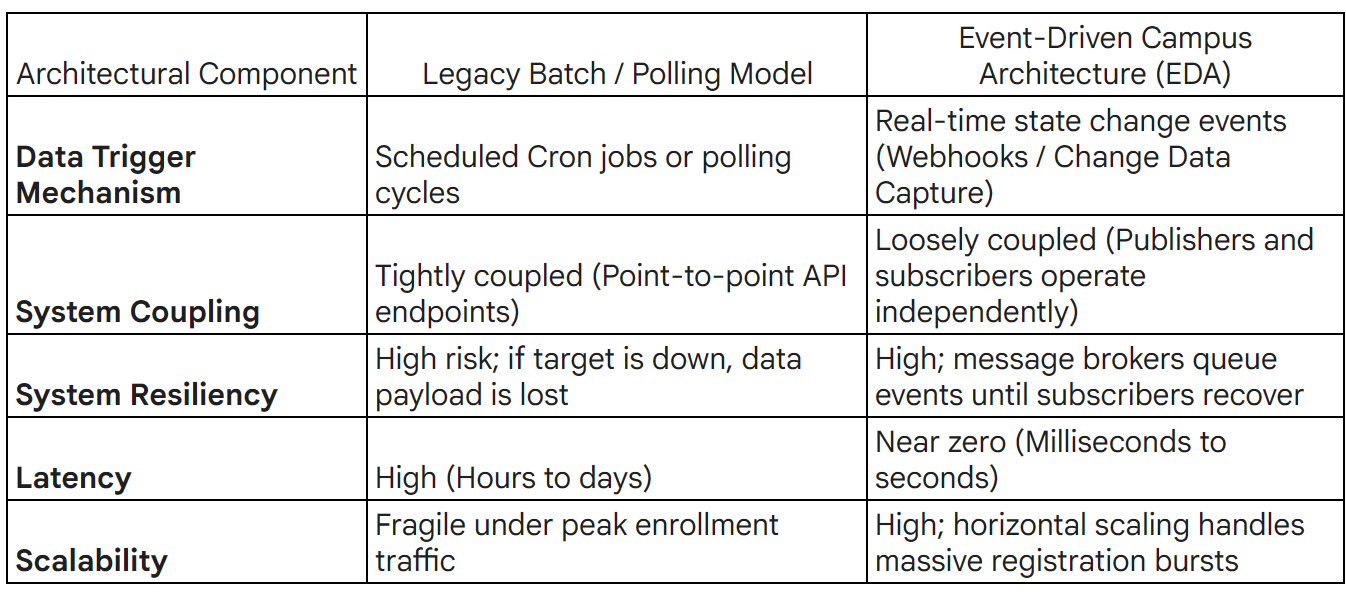
- Resource Waste and API Throttling: Polling endpoints when no data has changed wastes server resources and bandwidth. During registration spikes, thousands of polling requests can trigger vendor API rate limits, bringing core campus services to a halt.
- The "Stale Data" Window: Batch synchronization creates a data latency lag of 12 to 24 hours. If an advisor acts on yesterday's engagement data, their outreach may be irrelevant or counterproductive.
- Tight System Coupling: In a request-response model, the source system must know the destination, IP address, and payload schema of every downstream consumer. If the receiving database goes offline, the sending application's sync fails.
Core Components of an Event-Driven Campus
Event-Driven Architecture decouples system producers from system consumers using an asynchronous Publish/Subscribe (Pub/Sub) message broker (such as MuleSoft Anypoint MQ, Apache Kafka, or AWS EventBridge).
Instead of asking "Has anything changed?", applications publish an event notification the millisecond an action occurs.
3 High-Impact Real-Time Campus Workflows
Adopting an event-driven framework transforms how key campus departments interact:
1. Instant Academic Interventions
Event: A student receives a failing grade on a mid-term assessment in Canvas.
Action: The LMS publishes a StudentRiskScoreUpdated event. The event broker broadcasts this payload to the CRM (triggering an automated SMS check-in) and the advisor portal simultaneously.
2. Frictionless Enrollment & Billing
Event: A student completes tuition payment via the bursar portal.
Action: A PaymentProcessed event fires instantly. The SIS clears the registration hold within milliseconds, allowing the student to enroll in high-demand courses without delay.
3. Real-Time Institutional Intelligence
Event: Actions across housing, admissions, and course registration emit continuous event streams.
Action: Centralized dashboards like EdTech Analytics consume these event streams to give executive leadership live, cross-departmental visibility into campus health.
Build Event-Driven Architecture with Talentus Global
Transitioning legacy university infrastructure from batch processing to an asynchronous, event-driven mesh requires deep integration expertise across enterprise middleware, microservices, and Higher Ed software stacks.
Talentus Global provides the specialized engineering bandwidth to modernize your campus data flows.
With over 30 years of enterprise IT and digital transformation leadership, Talentus Global deploys pre-vetted, nearshore LATAM software engineering pods skilled in MuleSoft, Boomi, cloud-native Pub/Sub architectures, and custom API pipelines.
By leveraging our pre-engineered EdTech Connectors, university IT teams eliminate custom scripting bottlenecks and achieve seamless, real-time data streaming across Canvas, Slate, Banner, Workday, and Salesforce.
- 100% EST/CST Synchronization: Our LATAM engineering pods operate during your exact US business hours for real-time collaboration and daily agile standups.
- Zero Recruitment Delay: Bypass 60-day domestic hiring lags and deploy senior integration developers in under 48 hours.
- Unmatched Continuity: Maintain institutional memory with our industry-leading 95% developer retention rate.
Stop letting stale batch transfers slow down your digital campus. Build a real-time event-driven architecture with Talentus Global today.