Campus safety operations and emergency response efficacy depend heavily on real-time situational awareness.
However, at many higher education institutions, safety tools, emergency dispatch consoles, and security mobile apps operate in complete isolation from central Student Information Systems (SIS).
When a critical safety incident occurs, campus police and emergency response teams are forced to make decisions with limited context. Disconnected systems prevent security personnel from instantly knowing student class schedules, building access logs, or accessibility requirements during an active crisis. Furthermore, retrospective compliance reporting under federal mandates like the Clery Act remains a tedious, manual reconciliation process across disconnected spreadsheets and incident logs.
Integrating real-time incident reporting pipelines directly with core SIS platforms transforms campus security from a reactive dispatch model into an automated, context-aware safety architecture.
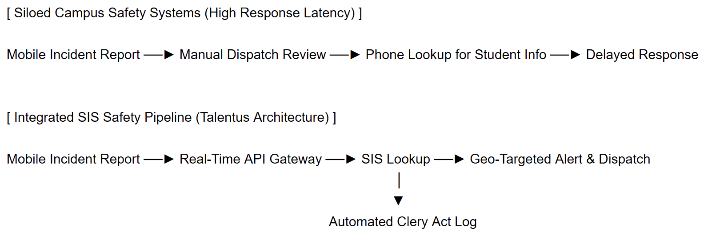
The High Risk of Siloed Campus Security Infrastructure
Managing campus safety without direct, real-time integration into university student records introduces severe operational vulnerabilities:
- Delayed Incident Resolution & Dispatch: Manually cross-referencing incident locations with student enrollment data or advisor directories slows down emergency response times during critical windows.
- Lack of Actionable Context in Crises: First responders lack immediate visibility into active class rosters, emergency contact preferences, or special accommodation requirements within impacted campus facilities.
- Compliance & Reporting Exposure: Compiling accurate, audit-ready statistics for the Jeanne Clery Act requires weeks of manual data gathering across campus safety logs, disciplinary records, and local law enforcement reports.
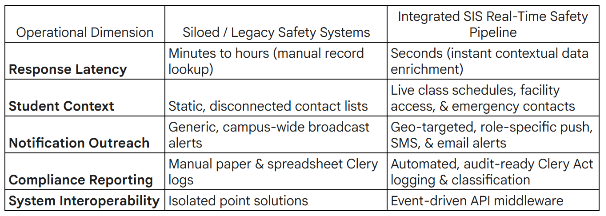
Siloed Safety Tools vs. Integrated Real-Time SIS Pipelines
Connecting safety applications directly to enterprise student data bridges the gap between emergency response speed and institutional compliance:
3 Pillars of Integrated Campus Safety Architecture
Building an enterprise-grade campus safety and incident reporting pipeline relies on three core technical capabilities:
1. Real-Time API Middleware & Webhook Integration
Connect mobile safety apps, blue-light emergency phones, and campus security consoles directly to your SIS database using event-driven API middleware. When an incident is flagged, webhooks instantly trigger bi-directional data flow, enriching the security alert with real-time student location and schedule data.
2. Contextual Location & Schedule Mapping
Leverage active enrollment records and course schedules inside platforms like Thesis Elements to map dynamic student locations during emergency situations. In the event of a localized facility hazard, automated pipelines send targeted notifications exclusively to students and faculty currently scheduled in that building.
3. Automated Clery Act Classification & Audit Trails
Eliminate manual compliance tracking by embedding automated categorization and audit logging into the incident reporting workflow. Safety events are automatically tagged according to federal Clery Act parameters, logged with immutable timestamps, and formatted into exportable annual security reporting dashboards.
Modernize Your Campus Safety Infrastructure with Talentus Global
Building real-time incident pipelines, custom API middleware, and secure SIS integrations requires senior cloud architects, database specialists, and higher ed software engineers.
Talentus Global provides dedicated nearshore LATAM software engineering pods to design, build, and secure your campus safety and integration workflows.
For over 30 years, Talentus Global has been a trusted technical partner in enterprise software engineering, cloud architecture, and higher ed digital transformation. Our nearshore LATAM development teams specialize in real-time middleware, mobile integration, API security, and enterprise platform connectors across Thesis Elements, Banner, Ellucian, and Workday.
Operating 100% synchronously in your US timezone (EST/CST), our pre-vetted LATAM engineering pods deploy in as little as 48 hours to accelerate your campus safety roadmap without communication or timezone barriers.
- 100% US Timezone Alignment: Collaborate synchronously with senior software developers during standard EST/CST working hours.
- Deploy in 48 Hours: Bypass domestic recruiting friction and launch specialized engineering pods immediately.
- 95% Developer Retention Rate: Protect codebase stability and maintain deep institutional knowledge across long-term initiatives.
Enhance campus safety and streamline compliance. Partner with Talentus Global today.