Deploying large language models (LLMs) into production requires a fundamental shift in traditional DevOps and MLOps practices.
Unlike deterministic software code or static machine learning models, LLMs present non-deterministic behavior, context-sensitivity, and susceptibility to silent failures like hallucinations, prompt regression, and latent data drift.
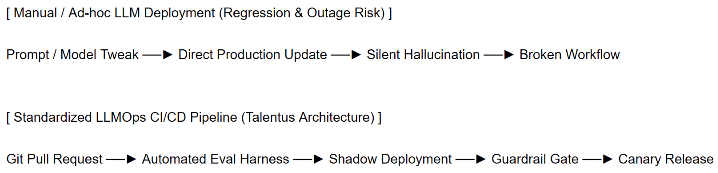
When enterprise AI teams update prompt templates, tweak RAG retrieval pipelines, or swap underlying model providers without automated evaluation gates, production systems break. A single untested prompt change can cause severe output degradation, increase token latency, or leak proprietary business logic.
Establishing a standardized LLMOps CI/CD pipeline brings engineering rigor to AI delivery, automating evaluation, regression testing, and deployment gates before model updates reach production users.
The High Risk of Unstandardized LLM Deployments
Relying on manual testing or ad-hoc prompt updates across multi-agent AI applications creates operational vulnerabilities:
- Unnoticed Prompt Regressions: Fixing an edge case in a prompt template often degrades performance on previously solved user queries.
- Cost & Latency Volatility: Changing model versions or expanding context window payloads can spike API costs and latency without warning.
- Compliance & Security Blind Spots: Deploying unvalidated updates risks breaking output guardrails, exposing sensitive enterprise data or generating toxic outputs.
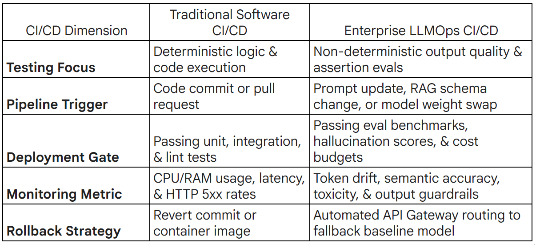
Traditional Software CI/CD vs. Enterprise LLMOps CI/CD
Standardizing your AI delivery pipeline requires moving beyond basic code linting and unit tests to continuous evaluation (CE):
3 Pillars of Standardized LLMOps CI/CD
Building an enterprise-grade delivery pipeline for generative AI relies on three core operational pillars:
1. Automated Evaluation Harnesses (Continuous Evals)
Treat prompts and RAG configurations as version-controlled code. Trigger automated evaluation suites (using tools like Ragas, DeepEval, or custom LLM-as-a-judge harnesses) on every pull request. Assert hard thresholds for semantic similarity, factual consistency, and answer relevance before code merge.
2. Shadow Deployments & Canary Releases
Never deploy model or prompt changes directly to 100% of live production traffic. Route a fraction of incoming production queries to a shadow environment running the new candidate model. Compare live output metrics against the baseline version in real time without impacting end users.
3. Real-Time Guardrail Gateways & Telemetry
Integrate runtime guardrails directly into your API gateway layer. Enforce strict JSON output schemas, automatically mask sensitive PII, and block toxic or off-topic responses. Continuous telemetry dashboards monitor token consumption, latency distribution, and semantic drift across every endpoint.
Scale Your LLMOps Infrastructure with Talentus Global
Standardizing CI/CD pipelines for production AI workflows requires senior MLOps engineers, cloud integration architects, and software specialists.
Talentus Global provides dedicated nearshore LATAM software engineering pods to build, scale, and secure your production AI infrastructure.
For over 30 years, Talentus Global has been a trusted technical partner in enterprise software engineering, cloud architecture, and MLOps. Our nearshore LATAM development teams specialize in AI pipeline automation, custom middleware, vector database architecture, and production LLM integrations.
Operating 100% synchronously in your US timezone (EST/CST), our pre-vetted LATAM engineering pods deploy in as little as 48 hours to accelerate your AI roadmap with zero timezone drag.
- 100% US Timezone Alignment: Collaborate synchronously with senior MLOps engineers during standard EST/CST business hours.
- Deploy in 48 Hours: Bypass domestic hiring bottlenecks and scale specialized AI pods immediately.
- 95% Developer Retention Rate: Retain deep architectural knowledge and codebase stability across long-term AI initiatives.
Eliminate deployment risks and standardize your LLMOps pipelines. Partner with Talentus Global today.