Higher education institutions are rushing to deploy generative AI, predictive analytics, and automated student workflows.
However, passing student records, transcripts, or advising notes through unvetted language models exposes universities to severe Family Educational Rights and Privacy Act (FERPA) violations.
For Chief Data Officers (CDOs) and university CISOs, the challenge is clear: enable campus-wide AI innovation without compromising Personally Identifiable Information (PII) or risking institutional funding.
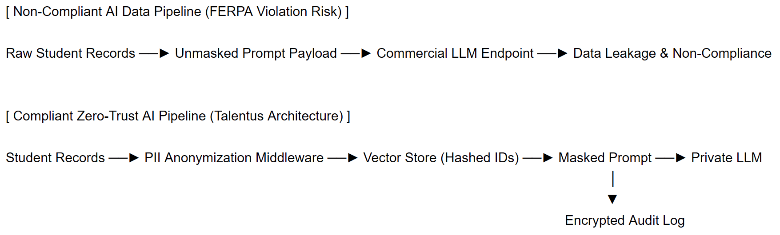
Achieving FERPA compliance in an AI-driven environment requires moving beyond standard terms of service. It demands dedicated technical guardrails, dynamic PII masking, Zero-Trust access controls, and audited RAG (Retrieval-Augmented Generation) pipelines that keep student data completely secure.
The Regulatory Risks of Ungoverned Campus AI
Integrating generative models into admissions, registrar, and advising workflows without architectural controls creates major compliance vulnerabilities:
- Unintentional Data Exposure: Feeding raw student transcripts or financial records into public or multi-tenant LLMs risks exposing PII in third-party model training sets.
- Opaque Data Provenance: Without centralized logging, tracking which AI agents or users accessed specific student records becomes impossible during a compliance audit.
- Directory Information Misclassification: AI systems that fail to enforce opt-out preferences for student directory information can inadvertently leak protected data through natural language queries.
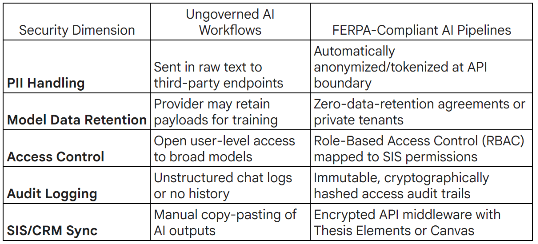
Ungoverned AI Workflows vs. FERPA-Compliant AI Pipelines
Protecting student privacy requires shifting from ad-hoc prompt usage to an enterprise, privacy-first data architecture:ç
3 Pillars of FERPA-Compliant AI Architecture
Chief Data Officers must implement three fundamental technical pillars to safely scale AI initiatives:
1. Dynamic PII Anonymization & Tokenization Middleware
Deploy an API proxy layer between student data stores and AI models. This middleware automatically detects, redacts, or pseudonymizes names, Social Security Numbers, student IDs, and grades before constructing prompt payloads. Re-identification happens strictly on-premise or within secure, authorized user sessions.
2. Zero-Trust Retrieval-Augmented Generation (RAG)
When grounding LLMs with university knowledge bases, enforce strict document-level security. Vector search queries must respect the active user's authorization level in the Student Information System (SIS), ensuring an academic advisor only retrieves records they are explicitly permitted to view.
3. Isolated Private Tenant or On-Premise LLM Deployments
Eliminate third-party data processing risks by deploying open-weights models within private cloud environments or dedicated single-tenant infrastructure governed by Business Associate Agreements (BAAs) and FERPA compliance clauses.
Secure Your Campus AI Architecture with Talentus Global
Designing FERPA-compliant AI pipelines, Zero-Trust middleware, and secure enterprise integrations requires senior cloud security architects, data engineers, and higher ed software specialists.
Talentus Global provides dedicated nearshore LATAM software engineering pods to build, secure, and scale your university AI infrastructure.
For over 30 years, Talentus Global has been a trusted technical partner in enterprise software engineering, cloud architecture, and higher ed digital transformation. Our nearshore LATAM development teams specialize in PII sanitization middleware, Zero-Trust RAG pipelines, API security, and enterprise integrations across Thesis Elements, Canvas, Ellucian, and custom campus databases.
Operating 100% synchronously in your US timezone (EST/CST), our pre-vetted LATAM engineering pods deploy in as little as 48 hours to accelerate your AI roadmap without compliance or timezone friction.
- 100% US Timezone Alignment: Collaborate synchronously with senior data security engineers during standard EST/CST working hours.
- Deploy in 48 Hours: Bypass domestic recruiting delays and launch specialized security engineering pods immediately.
- 95% Developer Retention Rate: Retain deep institutional security knowledge and codebase stability across long-term AI initiatives.
Mitigate compliance risk and innovate with confidence. Partner with Talentus Global today.