Financial aid offices across higher education face a compounding operational bottleneck: manual document verification.
During peak enrollment cycles, staff members spend thousands of hours manually reviewing tax transcripts, identity verification worksheets, and income statements to satisfy federal and institutional aid requirements.
When financial aid verification stalls, award letters are delayed. Prospective students left waiting in the dark often abandon their applications or enroll elsewhere, directly eroding institutional tuition revenue.
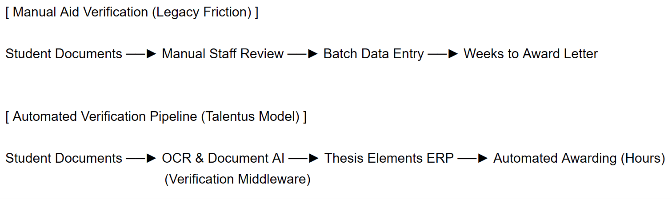
Modernizing financial aid processing requires shifting from manual document processing to automated verification pipelines. By combining Intelligent Document Processing (IDP) with direct integration into Enterprise Resource Planning (ERP) systems and Student Information Systems (SIS) like Thesis Elements, higher ed IT leaders can automate routine compliance checks and release student aid packages in hours rather than weeks.
The High Cost of Manual Financial Aid Processing
Relying on manual data entry and disconnected verification tools creates severe administrative friction across campus financial operations:
- Delayed Enrollment & Lost Revenue: Verification delays freeze financial aid packages. Students who cannot evaluate their true cost of attendance postpone enrollment decisions or drop out of the admissions funnel entirely.
- High Administrative Overhead: Financial aid counselors spend up to 70% of their time on repetitive document indexing and manual cross-referencing rather than providing high-value student counseling.
- Compliance and Audit Risks: Manual data transfers between document repositories and central ERP/SIS platforms lead to data entry errors, increasing vulnerability during federal aid compliance audits.
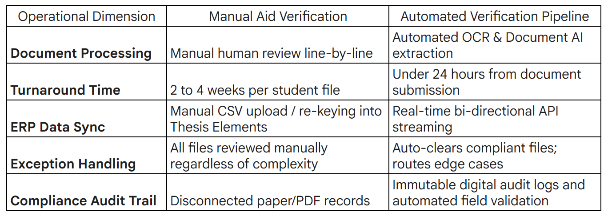
Manual Aid Verification vs. Automated Verification Pipelines
Upgrading financial aid operations modernizes institutional workflows while ensuring total regulatory compliance:
3 Pillars of Automated Financial Aid Pipelines
Building an enterprise financial aid verification pipeline requires three core technical components:
1. Intelligent Document Processing (IDP) & OCR Extraction
Deploy machine-learning-driven OCR engines to automatically ingest, classify, and extract data from tax forms, W-2s, and verification worksheets. Advanced IDP pipelines validate extracted tax values directly against FAFSA data points with high confidence scoring.
2. Real-Time ERP & SIS API Integration
Eliminate manual data re-keying. Secure middleware automatically pushes verified income and identity data directly into your central ERP and SIS (such as Thesis Elements or Ellucian), updating financial aid student statuses and clearing registration holds instantaneously.
3. Automated Rule-Based Exception Routing
Standardize compliance workflows. Straight-through processing automatically approves clear, fully matching student files, while intelligent rules engine algorithms flag only true discrepancies or edge cases for manual counselor review.
Modernize Your Campus Financial Aid Stack with Talentus Global
Building secure, automated document verification pipelines and enterprise ERP integrations requires specialized data engineering, AI workflow design, and deep Higher Ed systems domain expertise.
Talentus Global provides dedicated nearshore LATAM software engineering pods to build, integrate, and scale your financial aid technologies.
For over 30 years, Talentus Global has been a trusted technical partner in enterprise digital transformation and Higher Ed engineering. Our nearshore LATAM developers specialize in Intelligent Document Processing, cloud middleware development, API security, and ERP/SIS integrations (Thesis Elements, Ellucian, Salesforce).
Operating 100% synchronously in your US timezone (EST/CST), our pre-vetted LATAM engineering pods deploy in as little as 48 hours to streamline your financial workflows without domestic hiring delays.
- 100% US Timezone Alignment: Collaborate synchronously with senior engineers during standard EST/CST working hours.
- Deploy in 48 Hours: Bypass domestic hiring bottlenecks and launch specialized integration pods immediately.
- 95% Developer Retention Rate: Retain deep institutional knowledge and codebase stability across long-term initiatives.
Automate your financial aid verification pipeline. Partner with Talentus Global today clicking here