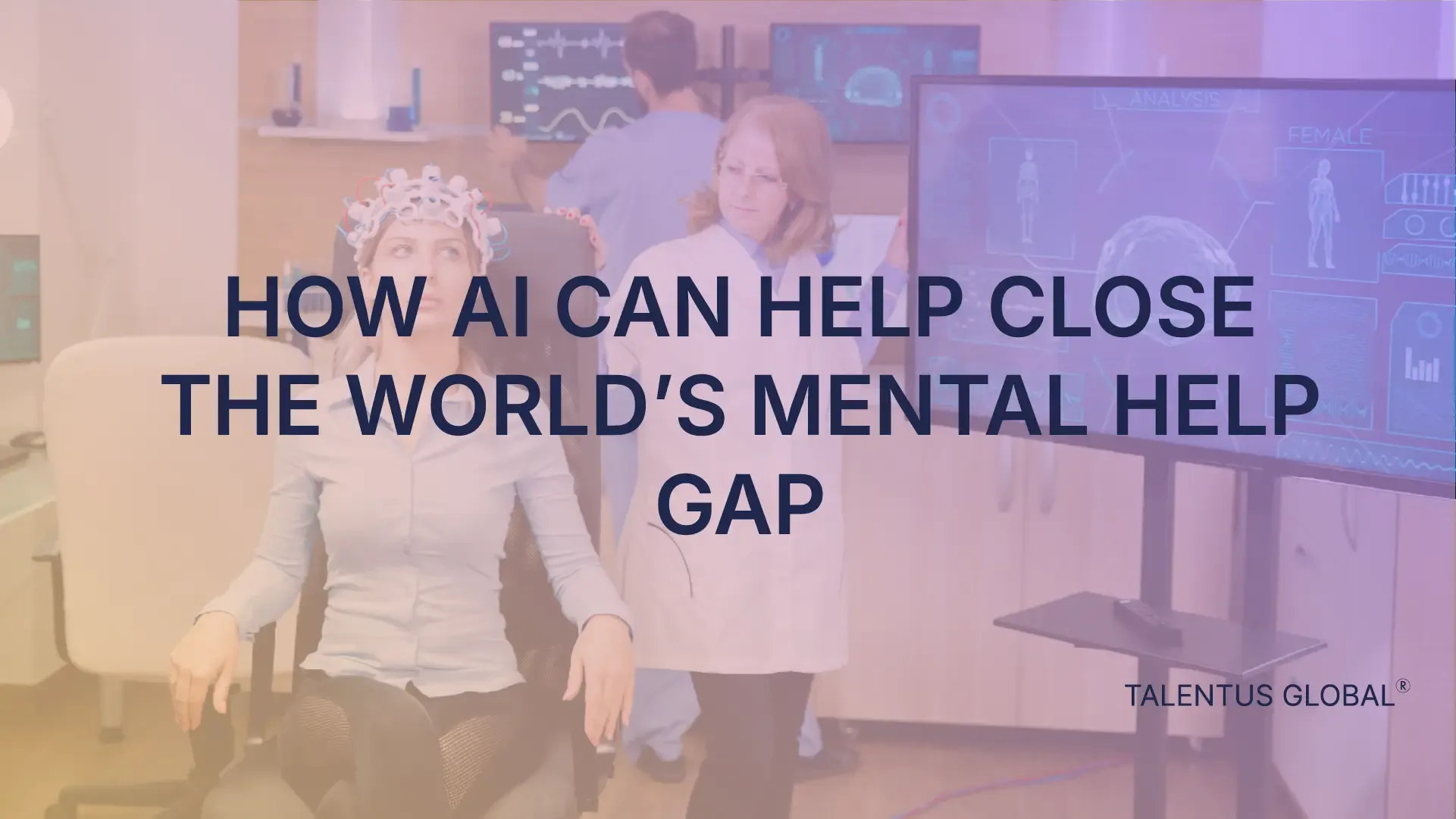
Mental illness is among the most significant public health concerns of our time. Even before the pandemic, over a billion people worldwide suffered from mental health or substance use disorders. COVID-19 merely exacerbated the problem, driving the rate of depression and anxiety cases up by 25% to 27%, according to the World Health Organization (WHO).
New research by Harvard Medical School and the University of Queensland indicates that nearly half of the global population is going to develop a mental disorder during their lifetime. Demand is booming, but the supply of mental health professionals is deplorably low.
There are only 13 mental health workers for every 100,000 of the population worldwide. In developed countries, that ratio is up to 40 times higher in poor regions. The consequence? A gigantic disparity in access, particularly in low- and middle-income countries, where up to 85% of people with mental illness receive no treatment at all, says the International Journal of Mental Health Systems.
AI as a Scalable Solution
Just as telehealth did during the pandemic, artificial intelligence (AI) is now being positioned as a scalable solution to expand access to care. A recent Oliver Wyman Forum survey of 16,000 people in 16 nations found that the majority are open to using AI-driven therapy solutions. In fact, 32% said they would be willing to use AI-powered solutions over a human therapist.
Interest is highest in countries where human therapists are least available. In India, 51% of the participants said they’d adopt AI therapy — more than twice the 24% in the U.S. and France.
AI’s role in mental health varies based on the severity and type of condition. But across a wide spectrum of needs, it can help fill critical gaps by offering scalable, affordable, and always-on support. For providers, AI can augment care by analyzing large datasets to personalize treatment plans and guide decision-making in real time.
AI-Powered Therapy in Practice
AI for mental health is already more than a concept. It’s already being used in several ways:
Clinical Decision Support: AI systems can analyze patient histories, clinical notes, and the latest medical literature to suggest personalized treatment plans and predict outcomes.
Conversational Tools: AI chatbots and self-help apps offer easy access to support for people with mild to moderate symptoms, lowering the barrier to help-seeking.
Remote Monitoring: AI can be used to monitor mood, behavioral patterns, and even voice and text sentiment to trigger early warning signs or relapse.
Generative AI, in particular, is transforming the experience of mental health care. Unlike other technology, such systems can simulate empathy, listen with no judgment, and provide responses that sound emotionally sensitive, at least to the user.
This is especially appealing to younger generations. Gen Z and millennials are more than twice as likely as older generations to have mental health issues, and more likely to seek therapy. According to Oliver Wyman Forum data, 36% of younger users said that they would use AI for mental health treatment, compared to 28% of other generations.
The Trust Factor: AI as an Emotional Confidant
Although it has no human sentiment, the majority of people consider generative AI to be a trustworthy confidant. In fact, five times more respondents said that AI made them feel like they had someone they could trust to talk to, compared to talking to a human. About 15% even said that they believe AI is more emotionally intelligent than humans.
That trust would create vast potential for AI to serve as a bridge — not a replacement — across global mental healthcare. Although AI is no panacea, its scalability and growing acceptance make it a thrilling tool to address one of the most pressing health access challenges of our time.
Learn more about how AI is helping to tackle the mental health crisis in America on the Chris Tech Chat podcast #8
Video unavailable until marketing cookies are enabled.