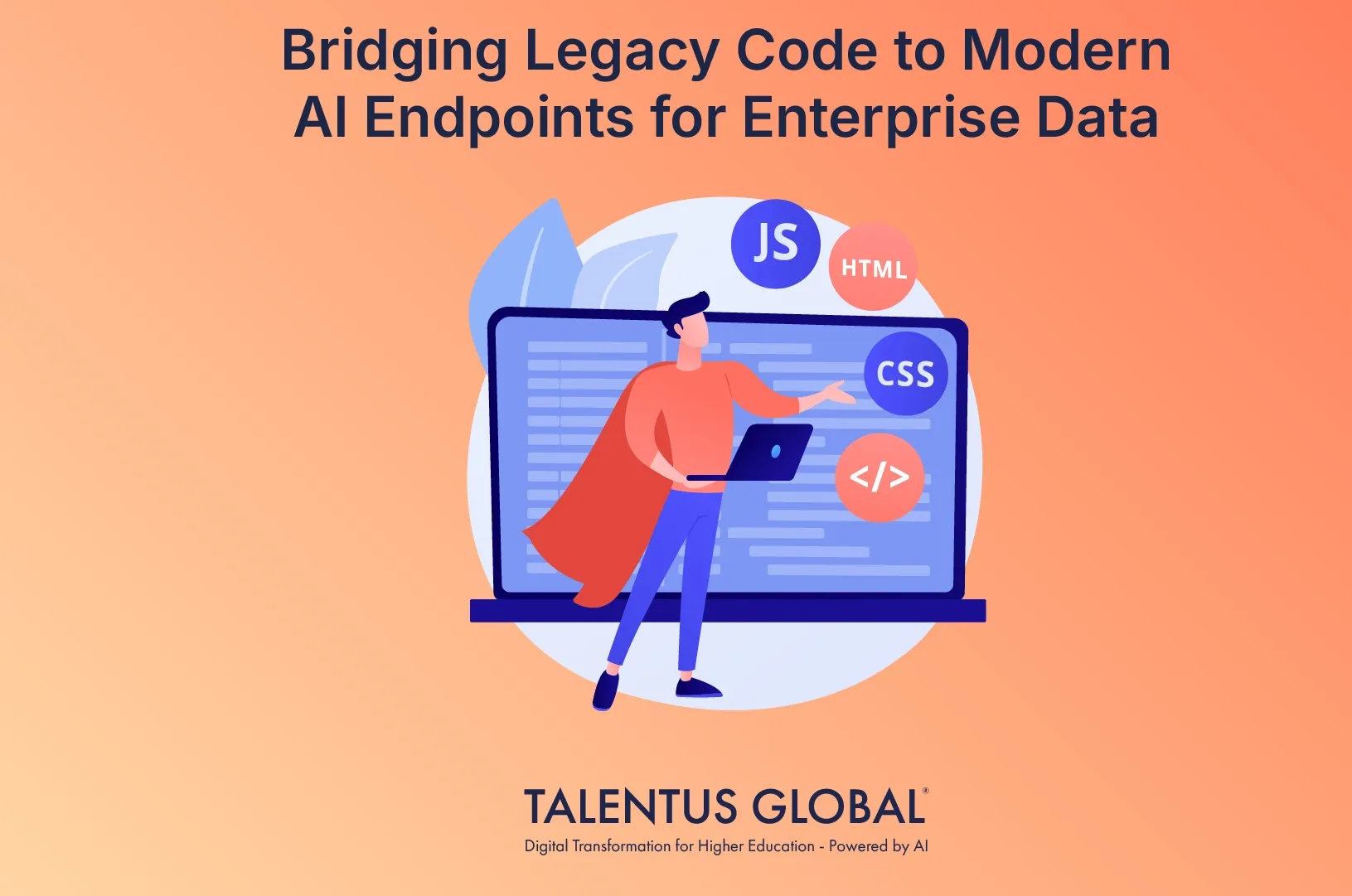
Enterprise institutions and higher education systems run on decades of foundational data stored in legacy relational databases, SOAP services, and on-premise systems of record.
While Generative AI endpoints, vector databases, and autonomous agents promise transformational efficiency, connecting them directly to brittle legacy backends is an architectural nightmare.
Legacy databases and core systems, such the ERP and the SIS, were built for batch processing, structured relational schemas, and predictable query loads. Conversely, modern AI endpoints require high-throughput JSON payloads, low-latency semantic vector embeddings, event-driven webhooks, and asynchronous streaming callbacks.
Attempting to hook foundation models directly into legacy databases creates severe performance bottlenecks, exposes sensitive records, and risks knocking down core enterprise backends during traffic spikes.
Legacy-to-AI Middleware serves as the intelligent abstraction layer that bridges this gap, translating, caching, securing, and orchestrating data flow between legacy enterprise systems and modern AI endpoints.
[ Legacy Systems of Record (Batch, Relational, High Latency) ]

  SIS     ──┐
  ERP      ─┼──► Legacy SQL / SOAP / Batch Feeds
  FinAid ───┘


[ Legacy-to-AI Middleware (Talentus Global Orchestration Layer) ]

  CDC Engine ──► Schema Transformer ──► Semantic Cache ──► Guardrail Proxy
                                │
                                ▼
[ Modern AI Ecosystem (Event-Driven, Low Latency, Tokenized) ]

  ├── Vector Databases
  ├── Frontier LLM APIs
  └── Agentic Tool Executors & Workflow Automation
The Risks of Direct Legacy-to-AI Integration
Forcing modern AI frameworks to interact directly with legacy enterprise databases without an intermediate middleware layer introduces critical operational friction:
- Database Lockup & Latency Spikes: High-frequency vector embedding ingestion or unindexed semantic queries from AI agents can overload legacy SQL tables, causing system-wide timeouts across core administrative operations.
- Payload & Protocol Mismatches: Legacy APIs communicate via verbose XML/SOAP protocols or raw database queries, while modern LLM endpoints require token-optimized JSON payloads with strict context window constraints.
- Data Security & Compliance Exposure: Passing unverified legacy database fields into AI prompts risks leaking protected student academic records (FERPA) or sensitive payroll data into model training logs or unauthorized LLM contexts.
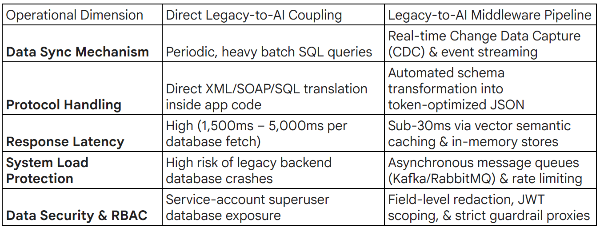
Direct Integration vs. Legacy-to-AI Middleware Architecture
Deploying custom integration middleware converts static, legacy record stores into high-availability AI pipelines:
3 Pillars of Legacy-to-AI Middleware Architecture
Building an enterprise-grade middleware pipeline to connect legacy backends with frontier AI systems relies on three core engineering pillars:
1. Real-Time Change Data Capture (CDC) & Vector Sync
Instead of hammering legacy databases with direct queries, deploy Change Data Capture (CDC) triggers to stream database updates in real time. As student records change in the SIS or financial aid balances update in the FinAid platform, the middleware automatically transforms the updated records into vector embeddings and syncs them directly with your vector database, ensuring your AI agents always operate on fresh enterprise ground truth.
2. Dynamic Schema Transformation & Token Optimization
Legacy databases often return hundreds of sparse, irrelevant columns per table. The middleware intercepts legacy payloads, strips out extraneous metadata, compresses structured tables into semantically rich markdown or JSON key-value pairs, and formats the data specifically for LLM context windows, reducing API token consumption by up to 60%.
3. Bidirectional Protocol Translation & Safe Tool Execution
When autonomous AI agents need to write back to legacy systems, such as scheduling an advising appointment in the CRM or updating a course status in the LMS, the middleware acts as a secure, bidirectional translator. It receives JSON function calls from the LLM, validates parameters against strict OpenAPI schemas, translates the call into the legacy REST/SOAP/SQL protocol, and executes the mutation safely under strict user RBAC policies.
Modernize Your Enterprise Infrastructure with Talentus Global
Bridging legacy enterprise backends with modern Generative AI endpoints requires senior cloud architects, database engineers, and MLOps integration specialists.
Talentus Global provides dedicated nearshore LATAM software engineering pods to design, build, and deploy custom Legacy-to-AI middleware pipelines.
For over 30 years, Talentus Global has been a trusted technical partner in enterprise software engineering, cloud architecture, and higher ed digital transformation. Our nearshore LATAM development teams specialize in API middleware, CDC streaming data pipelines, vector database architecture, and enterprise system integration across the CMR, LMS, SIS and the ERP
Operating 100% synchronously in your US timezone (EST/CST), our pre-vetted LATAM engineering pods deploy in as little as 48 hours to accelerate your AI modernization roadmap without communication or timezone friction.
- 100% US Timezone Alignment: Collaborate synchronously with senior software developers during standard EST/CST working hours.
- Deploy in 48 Hours: Bypass domestic recruiting friction and launch specialized integration pods immediately.
- 95% Developer Retention Rate: Retain deep institutional technical knowledge and codebase stability across long-term modernization efforts.
Unlock your legacy enterprise data for modern AI. Partner with Talentus Global today.