Higher education admissions and student retention teams routinely face a critical operational hurdle: key student data remains split between the CRM and SIS.
While admissions teams leverage the CRM to drive engagement, communications, and applicant pipelines, registrars and financial officers rely on the SIS as the single source of truth for academic records, billing, and enrollment status.
When these platforms rely on fragile batch exports or manual data transfers, applicant communication stalls, duplicate records proliferate, and advisors lose visibility into real-time student milestones.
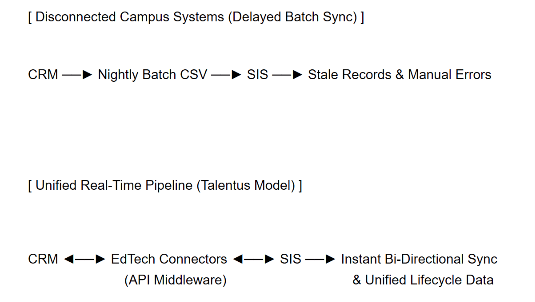
Unifying The CRM and SIS through an event-driven integration layer builds a bi-directional data pipeline that bridges the gap between prospective recruitment and long-term student success.
The High Cost of Disconnected CRM and SIS Platforms
Operating a CRM and SIS in isolation creates severe administrative friction across the student lifecycle:
- Delayed Admissions Follow-up: When an applicant submits key documentation or resolves a financial hold in the SIS, admissions counselors in the CRM may not see the update for hours or days, delaying offer letters and enrollment steps.
- Data Fragmentation and Duplication: Manual CSV uploads and batch scripts frequently generate duplicate student profiles, forcing IT and operations staff to spend hundreds of hours manually reconciling records.
- Brittle Custom Scripts: Custom-built API connectors between the CRM and enterprise SIS platforms break whenever vendor API schemas update, creating unexpected downtime during peak enrollment cycles.
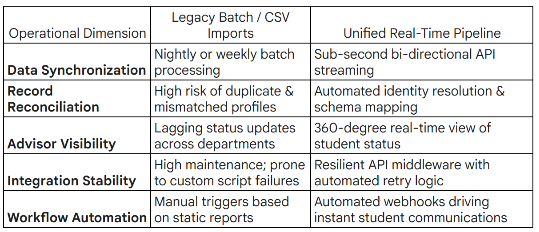
Legacy Batch Sync vs. Unified CRM and SIS Pipeline
Upgrading to an event-driven pipeline modernizes campus operations while ensuring absolute data integrity:
3 Pillars of a Unified Campus Data Pipeline
Creating a seamless integration between the CRM and the SIS requires three core architectural pillars:
1. Bi-Directional Event Streaming via API Middleware
Replace static batch files with dynamic webhook integration. Utilizing EdTech Connectors streams active updates, such as application status changes in the CRM or registration holds in the SIS, instantly across both systems without manual intervention.
2. Automated Schema Normalization & Identity Resolution
Eliminate duplicate student profiles. Standardize incoming data objects across the CRM and the SIS, ensuring that contact records, academic histories, and financial statuses map cleanly to a single master student identifier.
3. Closed-Loop Lifecycle Workflows
Connect admissions triggers directly to registrar actions. When an applicant accepts an offer in the CRM, the event automatically initializes student enrollment profiles in the SIS, instantly triggering orientation communications and advisor assignments.
Unify Your Campus Stack with Talentus Global
Building a robust, real-time integration pipeline between the CRM and the SIS requires senior data engineering talent and deep Higher Ed systems expertise.
Talentus Global provides dedicated nearshore LATAM software engineering pods to integrate, modernize, and scale your campus data ecosystem.
For over 30 years, Talentus Global has been a trusted leader in enterprise digital transformation and Higher Ed system engineering. Our nearshore LATAM developers specialize in API middleware development, Salesforce integration, enterprise SIS architecture, and real-time cloud data pipelines.
Operating 100% synchronously in your US timezone (EST/CST), our pre-vetted LATAM engineering pods deploy in as little as 48 hours to streamline your integrations without domestic recruitment delays.
- 100% US Timezone Alignment: Collaborate synchronously with senior developers during standard EST/CST working hours.
- Deploy in 48 Hours: Bypass domestic hiring bottlenecks and launch specialized integration pods immediately.
- 95% Developer Retention Rate: Retain deep institutional knowledge and codebase stability across long-term initiatives.
Unify your campus CRM and SIS ecosystems. Partner with Talentus Global today with our EdTech Connector clicking here