Scaling enterprise software teams is one of the most critical challenges facing CTOs, VPs of Engineering, and CIOs today.
When strategic product roadmaps demand rapid execution, engineering leaders face a classic dilemma: double down on traditional internal hiring or deploy dedicated nearshore software engineering pods.
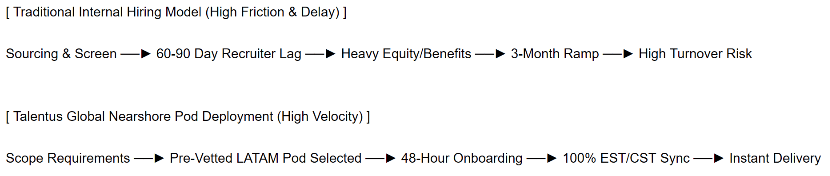
While internal hiring remains the default instinct for many organizations, the reality of domestic tech recruitment is fraught with friction, 60 to 90-day hiring cycles, steep recruiter commissions, rising fully-loaded compensation, and constant retention risks. Meanwhile, product timelines slip and market opportunities narrow.
Nearshore LATAM engineering pods offer a high-velocity alternative. By delivering pre-vetted, cross-functional engineering teams operating 100% synchronously in US timezones, nearshore pods provide the architectural stability and delivery speed of an in-house team at a fraction of the cost and onboarding overhead.
The High Cost of Domestic Hiring Friction
Relying solely on internal recruitment to scale complex software projects introduces hidden operational drains that erode engineering velocity:
- Extended Time-to-Market Delays: Sourcing, interviewing, and negotiating with senior domestic talent routinely takes 2 to 3 months per open head. Key feature releases sit idle while recruiting backlogs grow.
- Massive Fully-Loaded Expense: Beyond base salary, internal hires require recruiter fees (15–25%), healthcare benefits, equity grants, payroll taxes, equipment, and administrative overhead, inflating total cost by 30–40%.
- Scaling Inflexibility: When project demands shift or budgets tighten, reallocating or downsizing internal teams creates severe organizational friction, severance expenses, and team morale challenges.
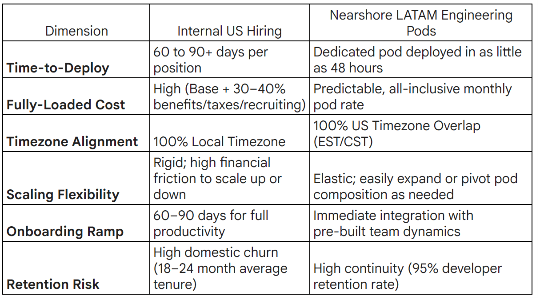
Internal US Hiring vs. Nearshore LATAM Engineering Pods
Comparing traditional recruitment against dedicated nearshore engineering pods reveals stark operational trade-offs across velocity, cost, and team agility:
3 Pillars of Nearshore Engineering Pod Efficiency
Unlocking true software engineering velocity through nearshore LATAM pods relies on three core operational pillars:
1. Instant Team Capacity & 48-Hour Onboarding
Rather than hiring individual developers piecemeal and waiting months for them to build working chemistry, nearshore pods arrive as cohesive, pre-vetted teams. Complete with senior developers, QA engineers, and technical leads, pods integrate directly into your existing Jira, GitHub, and Slack workflows within 48 hours.
2. 100% Synchronous EST/CST Timezone Overlap
Unlike offshore outsourcing models in Asia or Eastern Europe that suffer from 9.5-hour communication delays and asynchronous bottlenecks, LATAM nearshore pods operate in real time alongside your domestic team during standard US business hours (EST/CST). Standups, code reviews, and architectural syncs happen without timezone drag.
3. Deep Architectural Continuity & Retention Stability
High developer churn destroys codebase stability. Top-tier nearshore partners maintain industry-leading retention standards, such as a 95% retention rate, ensuring institutional domain knowledge stays intact and tech debt remains low across multi-year modernization initiatives.
Scale Your Engineering Velocity with Talentus Global
Building high-performing software teams without recruiting friction requires a trusted, long-term technical partner.
Talentus Global provides dedicated nearshore LATAM software engineering pods to accelerate your product roadmap with zero timezone drag.
For over 30 years, Talentus Global has been a trusted partner in enterprise software engineering, cloud architecture, MLOps, and higher ed digital transformation. Our nearshore LATAM development teams specialize in full-stack engineering, cloud modernization, enterprise API middleware, and AI pipeline integration.
Operating 100% synchronously in your US timezone (EST/CST), our pre-vetted LATAM engineering pods deploy in as little as 48 hours to eliminate hiring bottlenecks and deliver predictable, high-quality code.
- 100% US Timezone Alignment: Collaborate synchronously with senior engineers during standard EST/CST working hours.
- Deploy in 48 Hours: Bypass 90-day recruiting delays and launch specialized LATAM pods immediately.
- 95% Developer Retention Rate: Eliminate continuous retraining cycles and protect your codebase with long-term team continuity.
Eliminate hiring friction and scale your engineering capacity. Partner with Talentus Global today.