Ask any CTO or VP of Engineering about their biggest operational headache, and you will likely hear the same tug-of-war story. On one side, executive stakeholders and product leaders are pushing for new features to drive revenue and user engagement. On the other side, engineering leads are warning that the codebase is becoming a house of cards, held together by quick fixes, outdated dependencies, and fragile integrations.
Ignoring technical debt eventually brings feature velocity to a crawl. Bugs multiply, deployment cycle times stretch from days to weeks, and developer turnover spikes as engineers burn out fighting legacy code.
Yet, proposing a full roadmap freeze to "rewrite the system from scratch" is a non-starter for business leadership. Stopping product delivery for six months to refactor infrastructure risks losing market share and alienating customers.
To break this gridlock, tech leaders must abandon the binary choice between feature delivery and technical debt refactoring. By adopting a dual-track delivery model, organizations can pay down architectural debt while keeping the product roadmap moving forward.
Traditional Single-Track (Resource Friction)
Engineers ──► Feature Roadmap OR Tech Debt Refactoring (Trade-off Trap)
Dual-Track Parallel Delivery (Talentus Model)
Internal Core Team ──────► Product Roadmap & New Features
(Zero Velocity Loss)
Talentus LATAM Pod ──────► Tech Debt & System Refactoring
The Failure of the "Big Rewrite"
The temptation to halt feature work and launch a ground-up rewrite is understandable, but historical data shows it rarely succeeds. Big-bang rewrites suffer from continuous scope creep, unforeseen legacy edge cases, and massive budget overruns. Worse, while your engineering team is busy rebuilding existing functionality, competitors are eating away at your market share with new features.
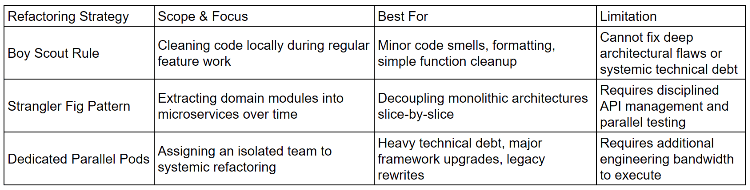
Instead of an all-or-nothing rewrite, successful engineering organizations use targeted strategies to modernize incrementally:
The Dual-Track Execution Model
While the Boy Scout Rule works well for daily maintenance, systemic technical debt, such as upgrading a core framework, migrating to a microservices architecture, or decoupling fragile APIs, requires dedicated engineering focus. If you ask your core developers to split their time between shipping new roadmap items and refactoring legacy modules, they will inevitably prioritize urgent feature requests, leaving technical debt untouched.
The solution is the Dual-Track Execution Model:
Protect the Internal Team's Roadmap Focus: Keep your core in-house developers focused on domain expertise, high-value feature development, and direct product roadmap objectives.
Deploy a Dedicated Refactoring Pod: Assign a specialized, parallel engineering pod whose sole objective is to refactor legacy code, write automated tests, and modernize architecture in the background.
By isolating the refactoring work into a dedicated pod, you eliminate context switching for your internal developers and guarantee that technical debt is systematically paid down every sprint.
Accelerate Refactoring with Talentus Global
The biggest obstacle to implementing a dual-track model is finding the engineering bandwidth. Hiring additional domestic developers to tackle technical debt is costly and slow, often taking 60 days or more just to complete the recruitment cycle.
Talentus Global provides the immediate capacity needed to resolve technical debt without pausing your roadmap.
With over 30 years of enterprise software engineering experience, we deploy pre-vetted, nearshore LATAM engineering pods proficient in cloud refactoring, API-first architecture, and legacy system modernization.
Immediate Deployment: Scale your engineering capacity in days, bypassing 60-day hiring delays.
Synchronous Alignment: Our LATAM pods operate in your exact US timezones (EST/CST) for real-time daily standups and seamless GitHub pull-request workflows.
Institutional Continuity: With an industry-leading 95% retention rate, the engineers who learn your codebase stay with you throughout the modernization lifecycle.
Stop letting legacy code dictate your product velocity. Pay down your technical debt and keep your roadmap alive with Talentus Global.