Higher education leaders face an increasingly complex admissions landscape defined by demographic shifts, evolving student expectations, and heightened competition for incoming classes.
Traditional Strategic Enrollment Management (SEM) has long relied on retrospective reporting, evaluating historical yield rates, regional benchmark data, and past admissions cycles to make projections for the upcoming year.
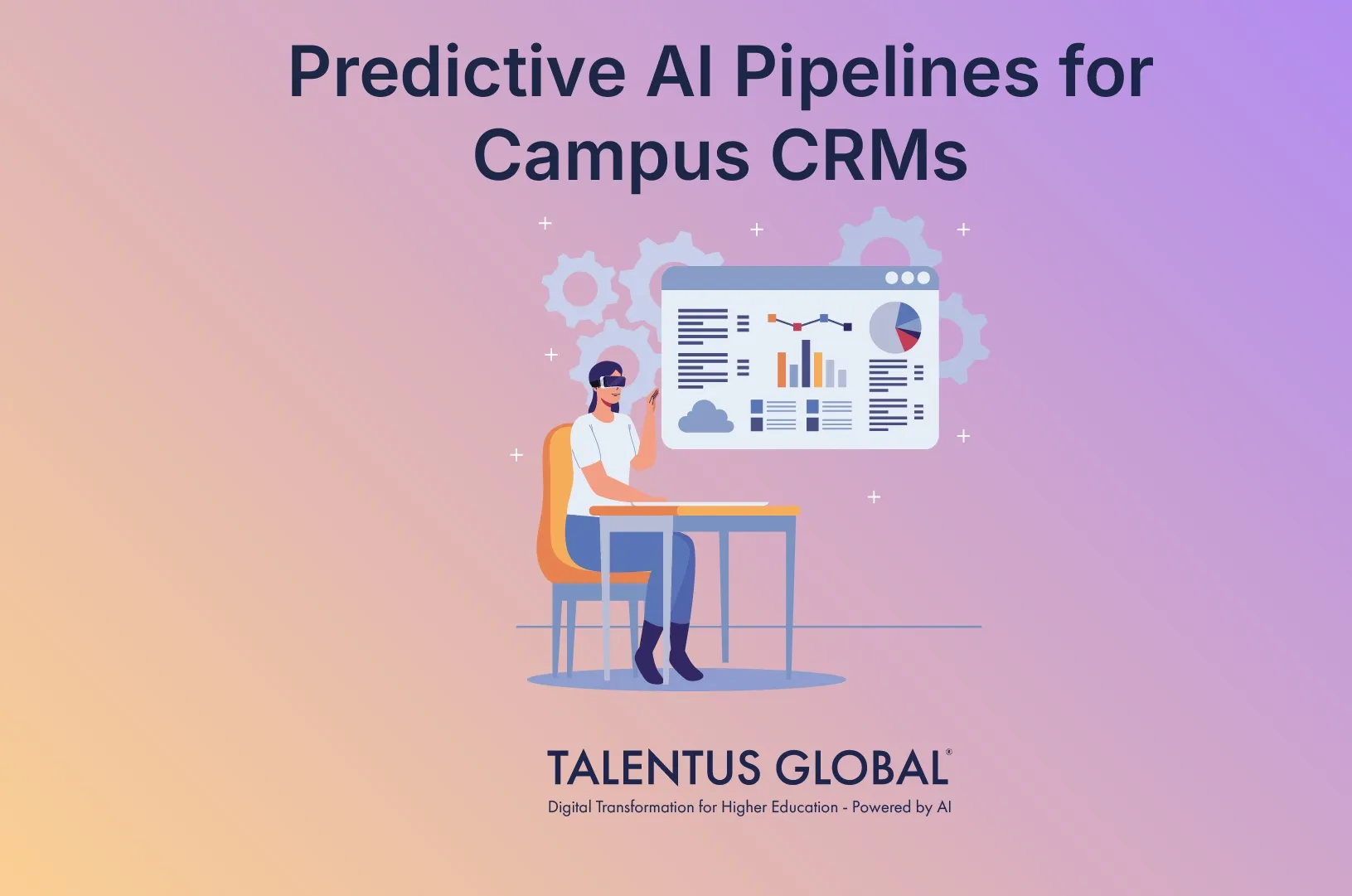
However, historical models struggle to adapt to modern, non-linear student journeys. Integrating predictive AI pipelines directly into an institution's Customer Relationship Management (CRM) platform shifts enrollment strategy from reactive reporting to real-time intervention, allowing admissions teams to optimize yield, allocate aid strategically, and reduce summer melt.
Understanding where friction occurs across the traditional enrollment funnel , from initial awareness down to deposit and enrollment, is essential for applying machine learning models effectively.
1. The SEM Evolution: From Static Funnels to Predictive Pipelines
The standard higher education admissions funnel routes prospective students through three primary psychological phases:
- Awareness Stage: Converting top-of-funnel Prospects into active Inquiries.
- Consideration Stage: Nurturing Applicants through document completion and application review.
- Decision Stage: Guiding Admits toward Deposits and ultimate Enrollment.
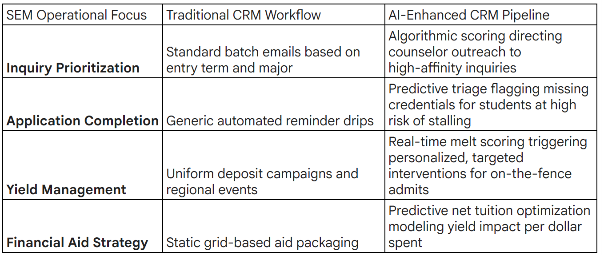
While static funnels measure historical conversion rates between these stages, a predictive AI pipeline overlay continuously analyzes behavioral signals and transactional CRM data in real time. Instead of treating every inquiry equally, predictive pipelines calculate dynamic probability scores for each student's likelihood to apply, deposit, and enroll.
2. Core Pillars of an AI-Driven Enrollment Pipeline
Building an intelligent CRM architecture requires moving beyond simple demographic segmentation toward multi-dimensional predictive modeling:
A. Behavioral Intent & Lead Scoring
Machine learning algorithms evaluate digital touchpoints, such as portal login frequency, campus tour registrations, email click-through rates, and Net Price Calculator completions inside the CRM. The pipeline assigns a real-time intent score to each prospect, helping admissions representatives prioritize high-touch outreach for leads showing strong interest or immediate friction.
B. Dynamic Financial Aid & Discount Matrix Optimization
Connecting predictive pipelines with core financial aid engines and your Student Information System allows models to evaluate historical aid and enrollment records. AI tools assist financial aid officers in structuring merit and need-based packages that maximize Net Tuition Revenue (NTR) while achieving institutional diversity and academic goals.
C. Early-Warning Yield & Summer Melt Scoring
The gap between initial deposit and day-one attendance represents one of the largest revenue leaks in higher education. Predictive models continuously evaluate post-deposit engagement signals (e.g., orientation sign-ups, housing application status, financial aid verification progress) to flag students at high risk of melting before classes begin.
Accelerate Your SEM AI Strategy with Talentus Global
Integrating predictive machine learning models, real-time data pipelines, and enterprise CRMs with core higher ed platforms requires specialized data engineering and cloud integration expertise.
Talentus Global provides dedicated nearshore LATAM software engineering pods to build, integrate, and deploy your AI-driven enrollment pipelines.
For over 30 years, Talentus Global has been a trusted technical partner in enterprise software engineering, cloud architecture, and higher ed digital transformation. Our nearshore LATAM development teams specialize in custom CRM extensions, predictive analytics middleware, real-time data ingestion pipelines, and enterprise systems integration.
Operating 100% synchronously in your US timezone (EST/CST), our pre-vetted LATAM engineering pods deploy in as little as 48 hours to accelerate your SEM AI roadmap without communication friction or timezone delays.
- 100% US Timezone Alignment: Collaborate synchronously with senior software developers during standard EST/CST working hours.
- Deploy in 48 Hours: Bypass domestic recruiting friction and launch specialized AI and CRM integration pods immediately.
- 95% Developer Retention Rate: Retain deep institutional technical knowledge and codebase stability across long-term modernization efforts.