Executive decision-making in higher education is often severely hindered by fragmented data.
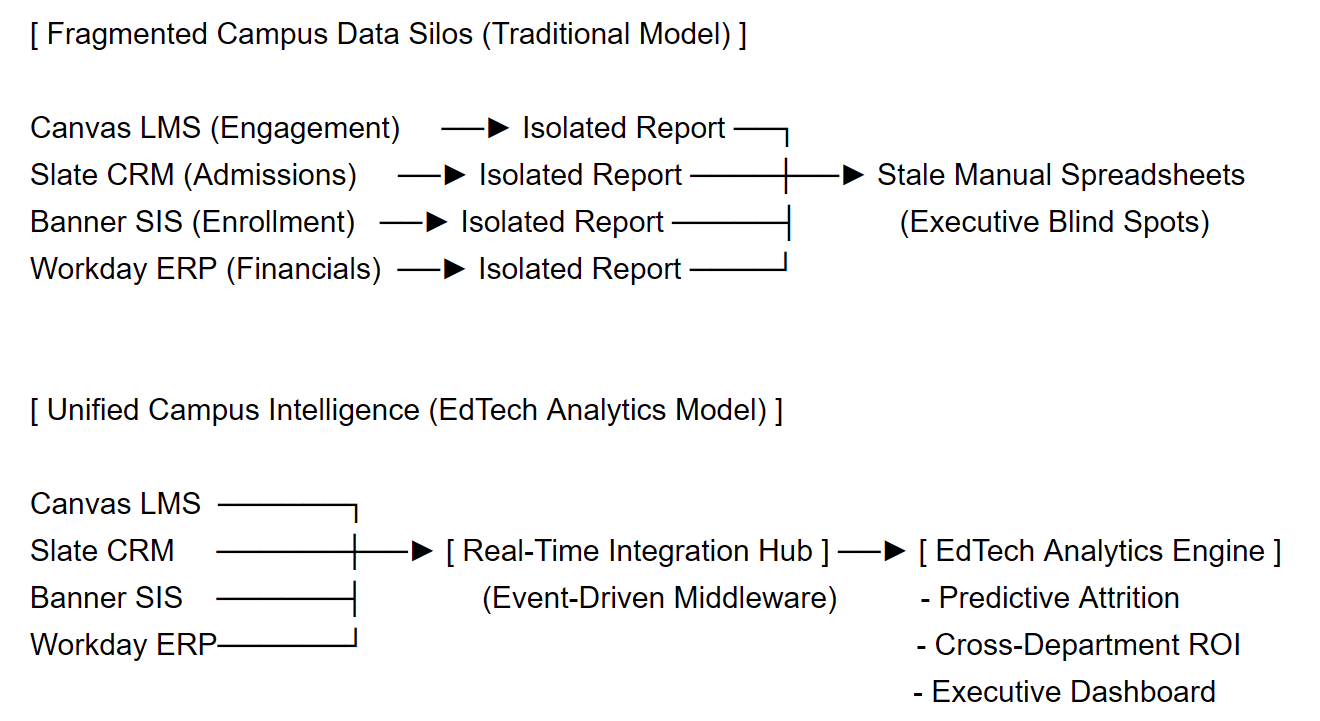
On a typical university campus, critical data resides in isolated departmental silos:
- The admissions team tracks prospective student velocity inside Slate or HubSpot.
- Faculty and instructional designers observe daily learning behaviors within Canvas or Blackboard.
- The registrar and bursar track enrollment statuses and fee payments in Banner, Workday, or PeopleSoft.
- The advancement team measures alumni lifetime engagement in Salesforce.
When university presidents, provosts, and CFOs attempt to answer fundamental strategic questions, such as "How does course engagement in the first six weeks correlate with retention and long-term tuition revenue?", they are forced to rely on manual data aggregation across multiple departments. By the time quarterly reports are compiled in static spreadsheets, the data is already stale, and the window for proactive intervention has closed.
To eliminate executive data blind spots and drive sustainable institutional growth, higher education leaders are turning to unified intelligence platforms like EdTech Analytics.
The Cost of Fragmented Campus Reporting
Relying on disconnected departmental reporting creates severe structural liabilities for mid-market and enterprise institutions alike:
- Reactive Attrition Management: Identifying student retention risks at the end of a semester—after final grades post—is too late. Without real-time behavioral data from the LMS mapped against financial aid and advising records, intervention teams cannot step in when a student first shows signs of disengagement.
- Inaccurate Financial Forecasting: University CFOs cannot accurately project tuition revenue if enrollment drop/add trends are not linked in real time to financial aid disbursements and General Ledger account balances.
- Uncoordinated Resource Allocation: Deciding which academic programs or physical facilities to expand requires combining course utilization rates, faculty costs, and applicant demand metrics into a single multi-dimensional model.
Siloed Reporting vs. Unified Campus Intelligence
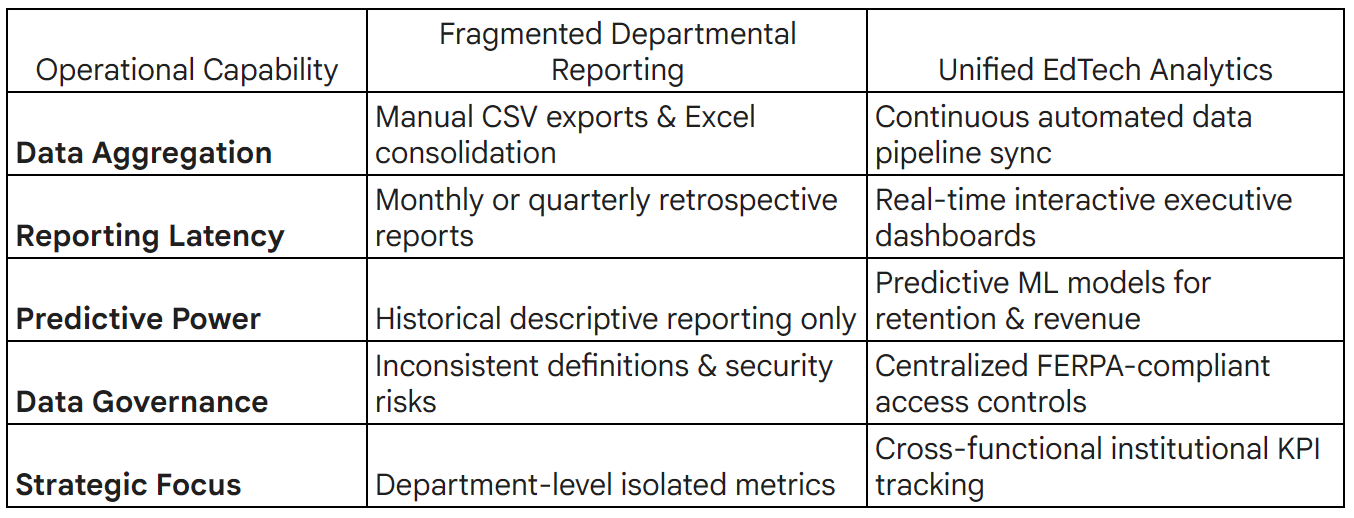
Transitioning from siloed reporting to centralized campus intelligence changes how university leadership operates across every dimension:
3 Pillars of Unified Campus Intelligence
Deploying a centralized intelligence layer through EdTech Analytics enables institutions to activate data across three critical operational pillars:
1. Predictive Attrition Modeling & Early Intervention
By continuously ingesting LMS login frequencies, assignment submission velocities, and discussion board activity, EdTech Analytics flags declining student engagement weeks before mid-term exams. Automated workflow triggers immediately alert academic advisors and support services inside the CRM, allowing for proactive, targeted outreach that directly protects student retention and tuition revenue.
2. Comprehensive Program & Course ROI
University leadership can evaluate the true financial and academic return on investment for individual courses and degree programs. By synthesizing faculty overhead, technology licensing costs, registration volume, and completion rates into unified dashboards, administrators can make data-backed decisions regarding curriculum expansion and budget allocation.
3. Real-Time Enrollment & Financial Health Monitoring
Executive leadership gains immediate visibility into the complete student lifecycle funnel, from initial applicant inquiry to final degree conferral and alumni giving. Live financial dashboards correlate course registration fluctuations directly with tuition revenue pipelines, ensuring CFOs and board members operate with absolute financial clarity.
Accelerate Campus Intelligence with Talentus Global
Building a unified campus intelligence platform requires robust data engineering, custom middleware pipeline creation, and seamless platform integration across complex Higher Ed software architectures.
Talentus Global provides the end-to-end technical expertise needed to unlock unified campus intelligence.
For over 30 years, Talentus Global has been a trusted leader in EdTech software engineering and digital transformation. Through our nearshore LATAM Global Delivery Centers, we deploy pre-vetted, highly specialized software engineering pods skilled in business intelligence, data engineering, cloud architecture, and API integration.
Our pre-engineered EdTech Connectors and EdTech Analytics solutions allow higher education institutions to bridge legacy data silos without long deployment timelines or custom scripting headaches.
- 100% Timezone Synchronization: Our nearshore engineering pods operate synchronously during your US operating hours (EST/CST) for real-time standups and seamless collaboration.
- Bypass Hiring Friction: Skip 60-day domestic recruitment delays and deploy specialized data engineering pods in under 48 hours.
- 95% Retention Guarantee: Protect institutional continuity throughout your digital transformation roadmap with our industry-leading developer retention.
Eliminate executive data blind spots and unify your digital campus. Explore EdTech Analytics and partner with Talentus Global today.