As enterprise AI architectures evolve from single-model integrations to autonomous multi-agent networks, machine-to-machine (M2M) API traffic is expanding exponentially.
Traditional API gateways, built to handle deterministic human-to-service or service-to-service requests, are structurally unprepared for the unpredictable execution loops, dynamic tool calls, and high-velocity payload flows generated by agentic AI networks.
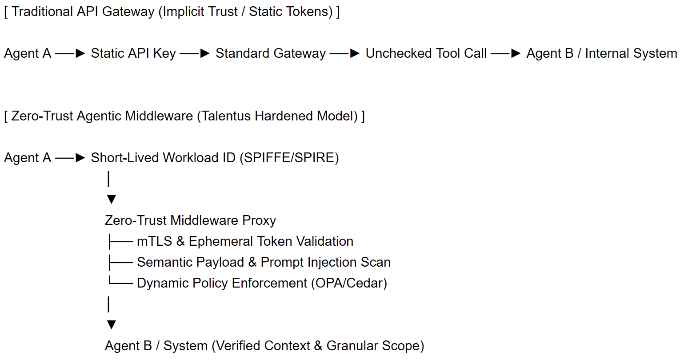
Allowing autonomous agents to interact across legacy gateways with static tokens or implicit internal trust creates critical security vectors: indirect prompt injections, unauthorized tool execution, and lateral movement across enterprise systems.
Hardening API gateways for multi-agent communication requires a Zero-Trust middleware architecture. By enforcing short-lived cryptographic identities, mutual TLS (mTLS), semantic payload inspection, and dynamic least-privilege policy enforcement at the gateway proxy layer, DevSecOps teams can secure autonomous agentic workflows at scale.
The Hidden Security Risks of Multi-Agent Networks
Deploying autonomous multi-agent workflows across conventional API infrastructure exposes organizations to novel threat vectors:
- Indirect Prompt Injection & Payload Contamination: A compromised or untrusted external data source can inject malicious instructions into Agent A's context, which Agent A then passes as a trusted tool parameter to Agent B, executing unauthorized system actions.
- Over-Privileged Machine Identities: Long-lived API keys or broad OAuth2 scopes give agents excessive system access. If an agent's execution loop strays or gets hijacked, it can pivot laterally across backend microservices.
- Non-Deterministic Execution Graphs: Traditional rate limiters rely on predictable endpoints and human interaction frequencies. Multi-agent loops can trigger hundreds of nested API calls per second, crashing upstream services or inflating LLM infrastructure costs.
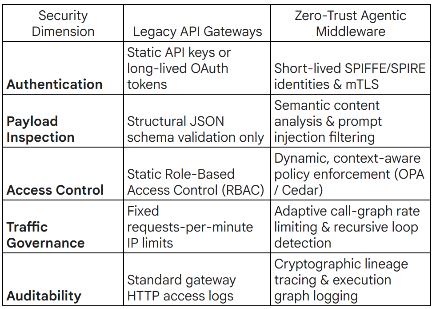
Legacy API Gateways vs. Zero-Trust Agentic Middleware
Upgrading your API gateway layer establishes strict security boundary controls without sacrificing inter-agent execution speed:
3 Pillars of Zero-Trust Middleware for Multi-Agent AI
Building a hardened Zero-Trust gateway for autonomous agent networks requires three core architectural controls:
1. Cryptographic Workload Identity & Ephemeral Tokens
Eliminate static API credentials across your agent mesh. Issue short-lived cryptographic identities using frameworks like SPIFFE/SPIRE. Require mutual TLS (mTLS) for all inter-agent communication, ensuring every agent service strictly proves its identity before transmitting payloads.
2. Semantic Payload Inspection & Injection Defense
Deploy real-time inline proxies that inspect payload contents between agent hops. Filter out known prompt injection patterns, validate function call parameters against strict schema boundaries, and block out-of-bounds tool calls before they reach execution targets.
3. Context-Aware Dynamic Authorization (OPA / Cedar)
Decouple authorization logic from agent code. Integrate policy engines like Open Policy Agent (OPA) or Cedar into the gateway sidecar. Evaluate execution context, agent state, and operational scope in real time to grant exact, temporary permissions for each specific tool execution.
Secure Your Agentic AI Infrastructure with Talentus Global
Architecting Zero-Trust API gateways and securing multi-agent AI ecosystems requires senior DevSecOps engineers, cloud security architects, and deep AI middleware expertise.
Talentus Global provides dedicated nearshore LATAM software engineering pods to design, harden, and scale your AI security infrastructure.
For over 30 years, Talentus Global has been a trusted technical partner in enterprise software engineering, cloud security, and DevSecOps transformation. Our nearshore LATAM developers specialize in Zero-Trust architecture, API gateway proxy development (Envoy, Kong, Tyk), SPIFFE/SPIRE integration, and LLMOps security middleware.
- Operating 100% synchronously in your US timezone (EST/CST), our pre-vetted LATAM engineering pods deploy in as little as 48 hours to accelerate your cybersecurity and AI roadmaps without domestic recruitment delays.
- 100% US Timezone Alignment: Collaborate synchronously with senior developers during standard EST/CST working hours.
- Deploy in 48 Hours: Bypass domestic hiring bottlenecks and launch specialized DevSecOps pods immediately.
- 95% Developer Retention Rate: Retain deep institutional context and codebase stability across long-term security initiatives.
Harden your multi-agent architecture today. Partner with Talentus Global clicking here