Somewhere in your applicant pool is the person you have been trying to hire for months. She led a team through a hard year, changed industries once, and took time off to care for a parent. Her résumé just doesn't use your exact words. Whether anyone ever reads it depends on how much authority you have handed to a filter.
AI resume screening can speed up hiring, but it can also filter out qualified people before anyone reads their story. Use AI to organize information and reduce administrative work, and keep the decision to advance or reject a candidate with people who can weigh experience, context and potential. The responsibility to recognize talent belongs to people.
As companies adopt AI agents and automated screening tools, one question deserves a serious answer: how much qualified talent is being filtered out before anyone takes the time to understand it?
How AI resume screening filters out qualified people
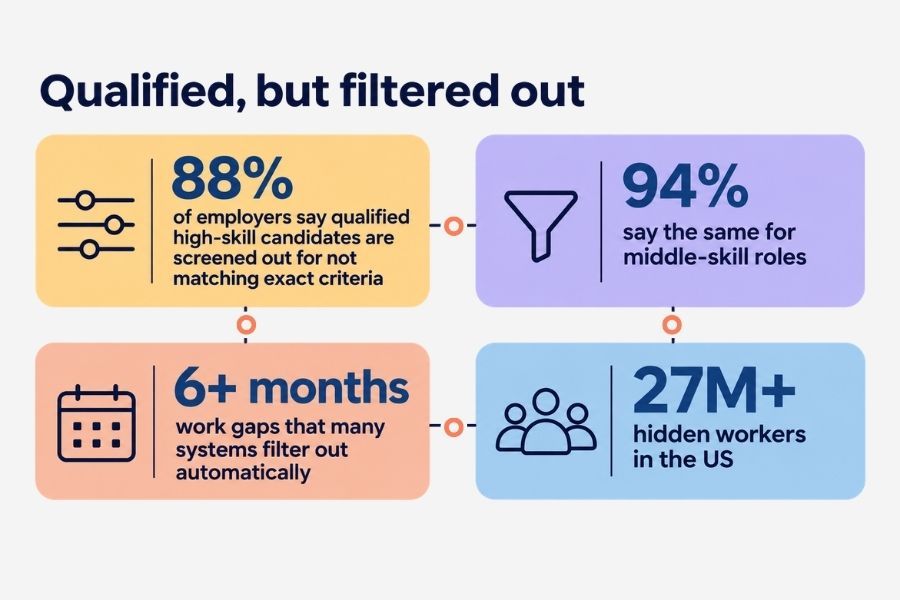
The problem predates today's AI agents, and the data is clear. In Hidden Workers: Untapped Talent, Harvard Business School and Accenture found that:
- 88% of employers said qualified high-skill candidates are vetted out because they do not match the exact criteria in a job description.
- For middle-skill roles, the figure rose to 94%.
- Many systems automatically screen out applicants with a gap of more than six months in their work history.
- More than 27 million people in the US fall into the "hidden worker" category that these systems tend to miss.
Rigid keyword filters and poorly designed AI screening repeat the same pattern at greater speed. Accomplished professionals are overlooked because their résumés do not mirror the exact language of a job posting.
What a keyword filter cannot see
Years of experience, demonstrated results, transferable skills and leadership through difficult circumstances all deserve thoughtful consideration. A filter that only matches words misses most of them.
- A different job title does not erase relevant experience. A "customer success lead" may have done exactly the account management your role requires.
- A career gap does not erase capability. People step away to care for family, study, recover or relocate, and they come back with the same skills.
- Missing a specific keyword does not make someone unqualified. Teams describe the same tools and methods in different words.
When screening ignores that context, it frustrates professionals and deprives employers of people who could make a meaningful contribution. The same study found that companies that hired hidden workers reported them performing better on key measures than workers from traditional sources.
A practical test: take five people who succeeded in the role and run their résumés through your current screen. If some of them would not pass, the filter is measuring the wrong things, and it is rejecting the very profile you want more of.
Behind every application is a person
Reducing someone's professional future to a keyword score is dehumanizing. Every application represents a livelihood, a family and an aspiration that deserve respect, including when the answer is no.
Candidates remember how they were treated. A silent automated rejection tells a skilled professional that nobody looked. That costs employers more than one hire: it shapes how talent talks about them for years.
Respect costs very little: a short note from a person, an honest timeline, and a way to ask a question. Those small gestures are what candidates remember long after the role is filled.
Where AI helps recruiters, and where people must decide
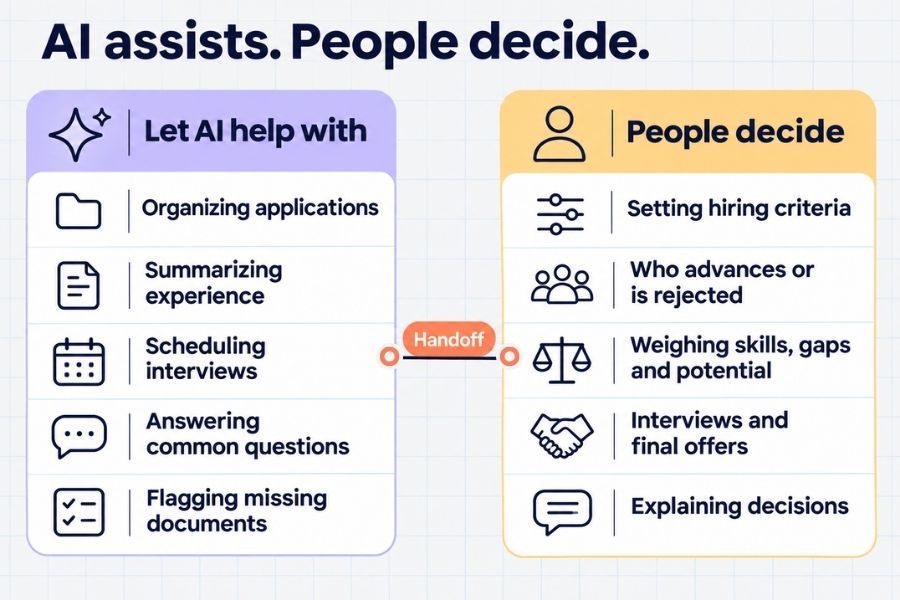
Human-centered AI in recruitment does not mean avoiding AI. It means putting it in the right place.
Let AI help with:
- Organizing applications and removing duplicates
- Summarizing experience so a recruiter can read faster
- Scheduling interviews and sending updates
- Answering common candidate questions
- Flagging missing documents
Keep people responsible for:
- Setting and reviewing the hiring criteria
- Deciding who advances and who is rejected
- Weighing transferable skills, gaps and potential
- Interviews and final offers
- Explaining decisions when candidates ask
Employers remain accountable for their tools
AI candidate screening does not move responsibility to the software vendor. Employers remain responsible for the criteria they set, the tools they deploy and the opportunities those tools may deny. Regulators increasingly agree:
- New York City's Local Law 144 bars employers from using an automated employment decision tool unless it has had a bias audit within the past year, and requires a public summary of the results and notice to candidates.
- European Commission guidance on the EU AI Act treats AI systems used for recruitment or selection, including tools that filter candidates, as potentially high-risk, with stricter obligations.
- The NIST AI Risk Management Framework gives organizations a voluntary structure to govern, map, measure and manage AI risks, including fairness.
Before you buy or renew a screening tool, ask the vendor three questions: what does the tool decide on its own, how was it tested for bias, and how does a recruiter override it? A vendor that cannot answer clearly is asking you to accept a risk you cannot see.
Compliance is the floor, not the goal. Responsible AI in hiring starts with a simple principle: no tool should hold unchecked authority over a person's opportunity.
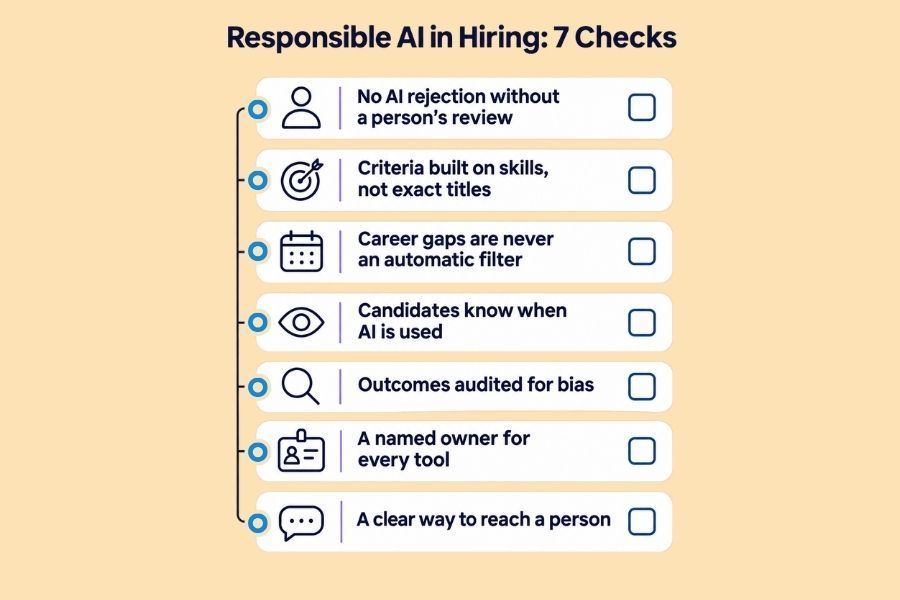
A checklist for responsible AI in hiring
- No candidate is rejected by AI without a person reviewing the decision.
- Criteria focus on skills and results, not exact titles or keywords.
- Career gaps are never an automatic filter.
- Candidates are told when AI is used, and for what.
- Outcomes are audited regularly for bias across groups.
- Every tool has a named owner who is accountable for it.
- Every applicant has a clear way to reach a person.
How Talentus Global approaches it
At Talentus Global, we have embraced AI across many business functions, and our own job postings say AI tools may support parts of the hiring process. We also believe that evaluating people requires human judgment and accountability. We do not give an AI agent unchecked authority to eliminate candidates without meaningful consideration of their experience, achievements and potential.
That principle runs through how we build teams for clients. In Smart Sourcing, every engineer goes through careful recruitment, technical interviews and assessments of logical and soft skills, with people making the calls. Our AI governance and security services apply the same thinking to the AI our clients deploy: useful tools, clear guardrails, and a person accountable for the outcome.
For talent acquisition teams, the takeaway is simple. AI can make recruiters faster. It should never make them absent.
FAQ
Does AI resume screening reject qualified candidates?
It can. In a Harvard Business School and Accenture study, 88% of employers said qualified high-skill candidates are screened out because they do not match the exact criteria of a job description. Rigid keywords, title matching and gap filters are the usual causes, which is why a person should review who gets rejected.
Should AI make hiring decisions?
No. AI can organize applications, summarize experience and handle scheduling, but the decision to advance or reject a person should rest with someone who can weigh context, potential and fairness. Employers remain accountable for those decisions, whatever tool was used to prepare them, and candidates deserve that accountability.
Are there laws on AI in hiring?
Yes, and more are coming. New York City requires a bias audit within one year before employers use automated employment decision tools, plus notice to candidates. The EU AI Act treats AI used to filter applications and evaluate candidates as high-risk. Check the rules that apply where you hire.
How can recruiters use AI responsibly?
Use AI for the work around the decision, not the decision itself. Write criteria around skills rather than exact titles, never filter out career gaps automatically, tell candidates when AI is used, audit outcomes regularly, and give every rejected applicant a path to a person. Name one owner accountable for each tool.
Next step
Building a team and want people, not filters, deciding who joins it? Schedule a consultation with Talentus Global. Looking for your next role? See our open positions.