Most admissions teams don't need an AI strategy. They need to know which calls to make first, which files are stuck, and which deposited students won't show up in August. That is where AI earns its place, and also where it can quietly cost you trust. Here is how to use it one stage at a time, with people still in charge of the decisions that matter.
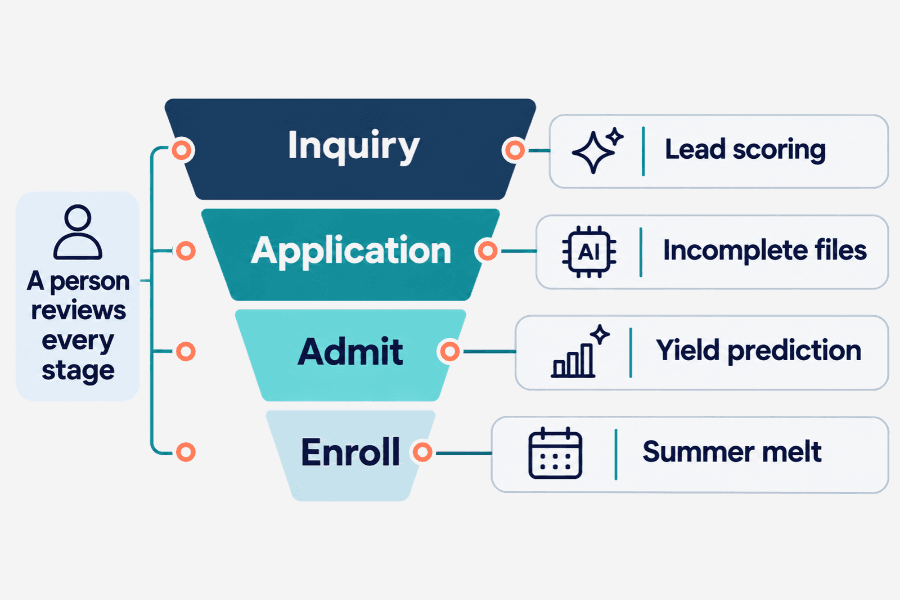
AI in student recruitment works best as an assistant at each stage of the funnel: it ranks inquiries, flags incomplete applications, estimates yield and spots students at risk of not enrolling. It should not make admission decisions, and a person should review what every model produces. Start with one use case, measure it for a term, and expand only if it earns its place.
The pressure to try is real. The National Student Clearinghouse Research Center's final fall 2025 report found total enrollment up 1.0%, while first-year enrollment was essentially flat, down 0.2%. Every first-year student is worth competing for, and that is exactly why the competition should not cost you their trust.
What AI can and cannot do in admissions today
AI in admissions is good at patterns. Given a few years of history, it can find which behaviors tend to come before an application or a deposit, rank students by likelihood, draft routine messages and route tasks to the right person.
It is weak at everything that is not in the data. It cannot judge fit or context, it does not know that you launched a new program or changed your aid policy this year, and it repeats whatever patterns, fair or not, it finds in past classes. It is also only as good as your CRM and SIS records.
Trust matters as much as accuracy. NACAC's 2026 Guide to Ethical Practice in College Admission asks members to promote ethical practices in the use of AI, consistent with transparency, integrity, fairness and respect for student dignity, and to protect student data privacy across every platform they use.
Inquiry: scoring leads so counselors call the right people first
Lead scoring in higher education ranks inquiries by how likely each student is to apply, using signals such as campus visits, event attendance, email engagement and program interest. Counselors start each day at the top of the list instead of working it alphabetically.
- What a person reviews: the scoring logic and its results across student groups. If the model favors zip codes or high schools that enrolled well in the past, it can quietly narrow your pool.
- What to measure: the application rate of students contacted from the top of the list, compared with the same point last cycle.
Application: flagging incomplete files
AI can check each file for missing transcripts, recommendations or test scores, catch mismatched names across documents and draft a reminder to the student. It is low risk, easy to measure and often the best place to start.
- What a person reviews: every reminder template before it goes live, and edge cases such as international documents or name changes.
- What to measure: the share of files complete by the deadline, and the days from submission to a complete file.
Admit: predicting yield
Predictive enrollment analytics estimates how likely each admitted student is to deposit, based on engagement, distance, program and financial aid. It helps you decide where yield outreach matters most, plan class size and test aid scenarios before you commit.
- What a person reviews: any use of the prediction in financial aid. A yield score should inform outreach, not decide who receives an aid offer or how large it is.
- What to measure: how close the forecast came to actual deposits, by program.
Enroll: spotting summer melt
Summer melt is the gap between students who deposit and students who arrive in the fall. Enrollment management AI can flag early signals: no orientation registration, unfinished financial aid steps, a missing housing form or weeks without opening an email.
- What a person reviews: the outreach itself. A flag should lead to a helpful call or text from a counselor, never to a penalty or a cold automated warning.
- What to measure: the melt rate compared with the prior year, and how many flagged students a counselor reached.
Guardrails for AI in student recruitment: what a person must always review
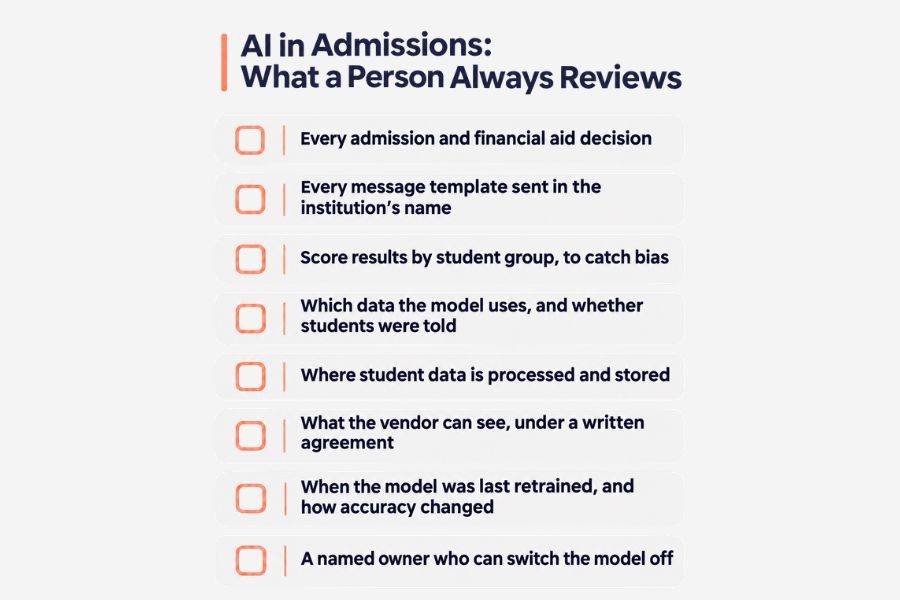
Use this checklist before any model goes live, and again every term.
- Every admission and financial aid decision
- Every message template sent in the institution's name
- Score results by student group, to catch bias
- Which data the model uses, and whether students were told
- Where student data is processed and stored
- What the vendor can see, under a written agreement
- When the model was last retrained, and how accuracy changed
- A named owner who can switch the model off
For the data side of this list, our post on AI data security in higher education covers where student data goes and what to ask vendors. Under FERPA, a vendor that handles education records must meet the school official conditions, including your direct control over how the records are used.
How to start: feasibility, pilot, scale
Measurement is where most AI projects fall short. In EDUCAUSE's 2026 study on AI and work in higher education, only 13% of respondents said their institution measures the return on its AI investments. Build the measurement in from day one, in three steps:
- Feasibility. Check whether your data can support the use case: how many years of history you have, where the gaps are, and what a model could realistically predict. End with a clear go or no-go.
- Pilot. Build a limited model for one use case and validate it with the admissions or advising team for one term, against the baseline you recorded.
- Scale. Only if the pilot moved the metric: automate the data syncs, monitor accuracy over time and add the next use case.
Talentus Global's AI analytics for enrollment follow this same sequence, with a go/no-go recommendation at the end of the feasibility analysis. The Enrollment Vista covers lead scoring, conversion prediction, yield optimization and enrollment forecasting, alongside Retention, Learning and Employability Vistas.
AI is one part of recruitment, not all of it. Barry University credits Talentus Global's digital marketing work with changes to its web presence and branding that translated into increased enrollments; you can find more examples in our higher ed success stories.
FAQ
How is AI used in student recruitment?
Colleges use AI to rank inquiries by likelihood to apply, flag incomplete applications, estimate which admitted students will enroll, and spot deposited students at risk of not showing up. The output tells counselors where to spend their time. Final decisions on admission and financial aid should stay with people.
Can AI make admission decisions?
It should not make them alone. AI can sort, flag and summarize, but admission decisions involve judgment, context and institutional values that a model trained on past classes cannot capture. Use AI to prepare information for reviewers, keep a person accountable for every decision, and be open with applicants about how AI is used.
What data does predictive enrollment analytics need?
Usually several years of history from your CRM and SIS: inquiries, applications, admit decisions, deposits and enrollment, plus engagement data such as campus visits and email activity. Financial aid data improves yield models. Data quality matters more than volume, so a feasibility check should come before any model is built.
How do we measure whether AI is working in admissions?
Pick one metric per use case before the pilot starts, such as application completion rate or summer melt, and record the baseline. Run the pilot for one term and compare it with the same period last year. If the metric does not move, adjust or stop. Do not scale on enthusiasm alone.
Next step
Not sure which use case to start with? Talk to an EdTech specialist about a feasibility analysis, and find out whether your data is ready before you build anything.