
Same hours, same workweek, same team. Here is a plain guide to building tech teams in Latin America: what sets it apart from offshore, how Mexico, Colombia, Argentina, Peru, Costa Rica and Brazil compare, and what to check before you sign on.
Nearshoring means building part of your technology team in a nearby country that shares your working hours. For US companies and universities, that usually means Latin America, where engineers work the same day as your team, often in the same time zone. The result is real-time collaboration, faster hiring and fewer hand-offs than offshore models.
This guide answers the four questions buyers ask first: why nearshore, which countries, what the real trade-offs are, and what a nearshore partner should prove before you sign.
What nearshoring is, in plain words
There are three common ways to source technology talent:
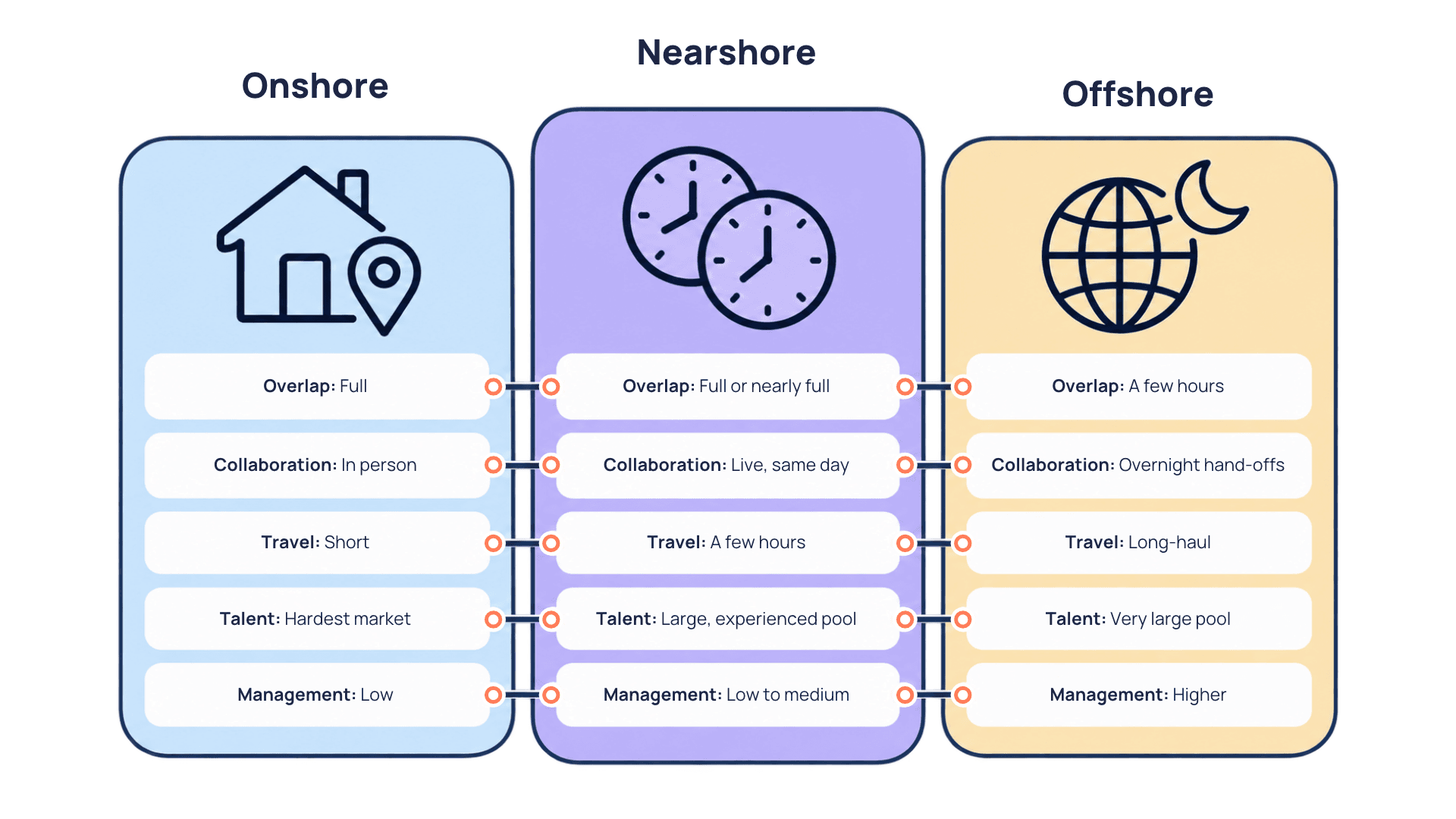
- Onshoring: hiring in your own country. Easiest to manage, but the hardest and slowest market to hire in for many roles.
- Offshoring: working with teams far away, often 9 to 12 hours apart. Lower rates, but most collaboration happens through hand-offs and overnight waits.
- Nearshoring: working with teams in nearby countries with a small time difference. For the US, that means Mexico, Central America and South America.
Nearshoring is not about replacing your team. It is about adding people who can join your meetings, answer questions the same afternoon and ship work inside your normal week.
Why companies choose nearshoring
Demand for software talent in the US keeps growing. The US Bureau of Labor Statistics projects employment of software developers, QA analysts and testers to grow 10% from 2025 to 2035, with about 106,100 openings each year. Finding experienced people fast is the challenge for most engineering leaders.
That is why the reasons to look south go beyond cost. In Deloitte's 2024 Global Outsourcing Survey of more than 500 executives, access to talent emerged as the number-one driver of outsourcing decisions, and 80% of executives planned to maintain or increase their investment in third-party outsourcing.
Nearshoring to Latin America adds four practical advantages:
- Shared hours. Teams work in the same time zone as the US or within one to two hours, so daily stand-ups and quick fixes happen in real time.
- Collaboration. Engineers join planning, reviews and demos as part of your team, not as a separate shift.
- Cultural fit. Many Latin American professionals have worked with US companies for years and are used to US business norms.
- Speed to hire. A larger pool of experienced engineers can shorten the time it takes to fill a role.
Which countries, and what each is known for
These are the best countries for nearshoring that US teams consider most often. Time differences compare each capital with US Eastern Time. English levels come from the EF English Proficiency Index 2025, which measures national averages, so always test English for each role.
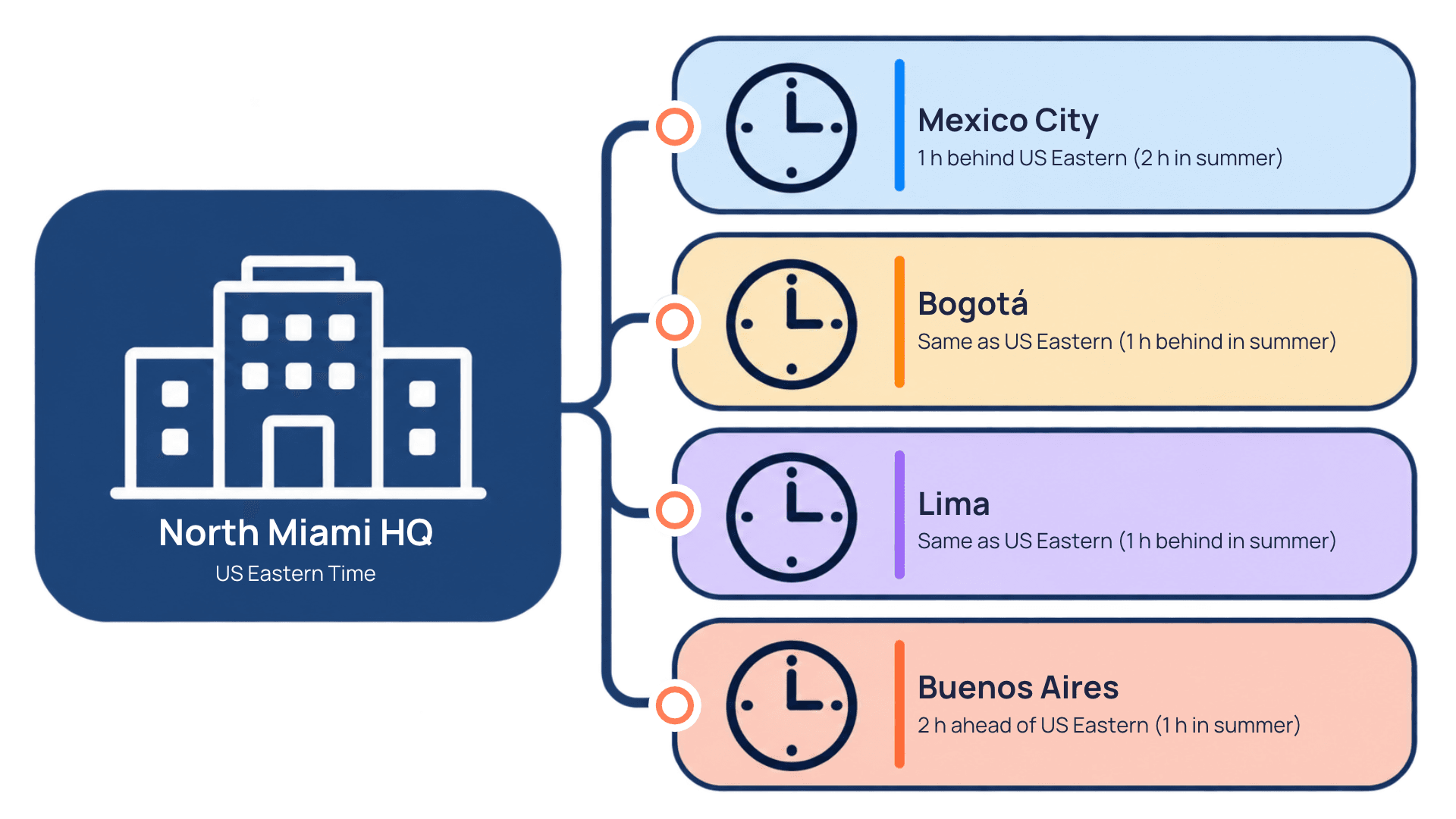
- Mexico. 1 hour behind Eastern in winter, 2 hours in summer (Mexico City does not change its clocks). One of the largest tech workforces close to the US, with strong enterprise software and web development experience. National English average is low; tech hubs vary.
- Colombia. Same time as Eastern in winter, 1 hour behind in summer. Fast-growing tech hubs in Bogotá and Medellín, with strong web, mobile and QA talent. National English average is low, so test English by role.
- Argentina. 1 to 2 hours ahead of Eastern, depending on the season. Known for senior engineers, product and design talent. Leads Latin America in the EF index, in the "high" proficiency band.
- Peru. Same time as Eastern in winter, 1 hour behind in summer. A growing talent pool in Lima with enterprise systems and data experience. "Moderate" English proficiency in the EF index.
- Costa Rica. 1 hour behind Eastern in winter, 2 in summer. A long-established services hub with many multinational companies. "Moderate" English proficiency in the EF index.
- Brazil. 1 to 2 hours ahead of Eastern, depending on the season. The largest talent pool in Latin America, deep in fintech, data and large-scale systems. Portuguese-speaking, with a low national English average.
Nearshore vs offshore: an honest comparison
Both models can work. The right choice depends on how closely the team needs to work with yours.
- Time-zone overlap. Nearshore: a full or nearly full shared workday. Offshore: a few hours of overlap at most.
- Collaboration. Nearshore: live meetings, pair programming and same-day answers. Offshore: more written hand-offs and overnight cycles.
- Travel. Nearshore: a few hours by plane, often a direct flight from Miami. Offshore: long-haul travel across several time zones.
- Cost. Nearshore rates are higher than offshore rates. You pay for overlap, communication and speed.
- Best fit. Nearshore suits product teams, agile work and anything that needs fast feedback. Offshore suits well-defined work that can run on a separate schedule.
There are trade-offs to plan for on the nearshore side too. Top engineers are in high demand in every Latin American hub, so retention takes real effort. Public holidays and labor rules also differ by country. A good partner plans for both, with clear retention practices and a shared holiday calendar from day one.
What to look for in a nearshore partner
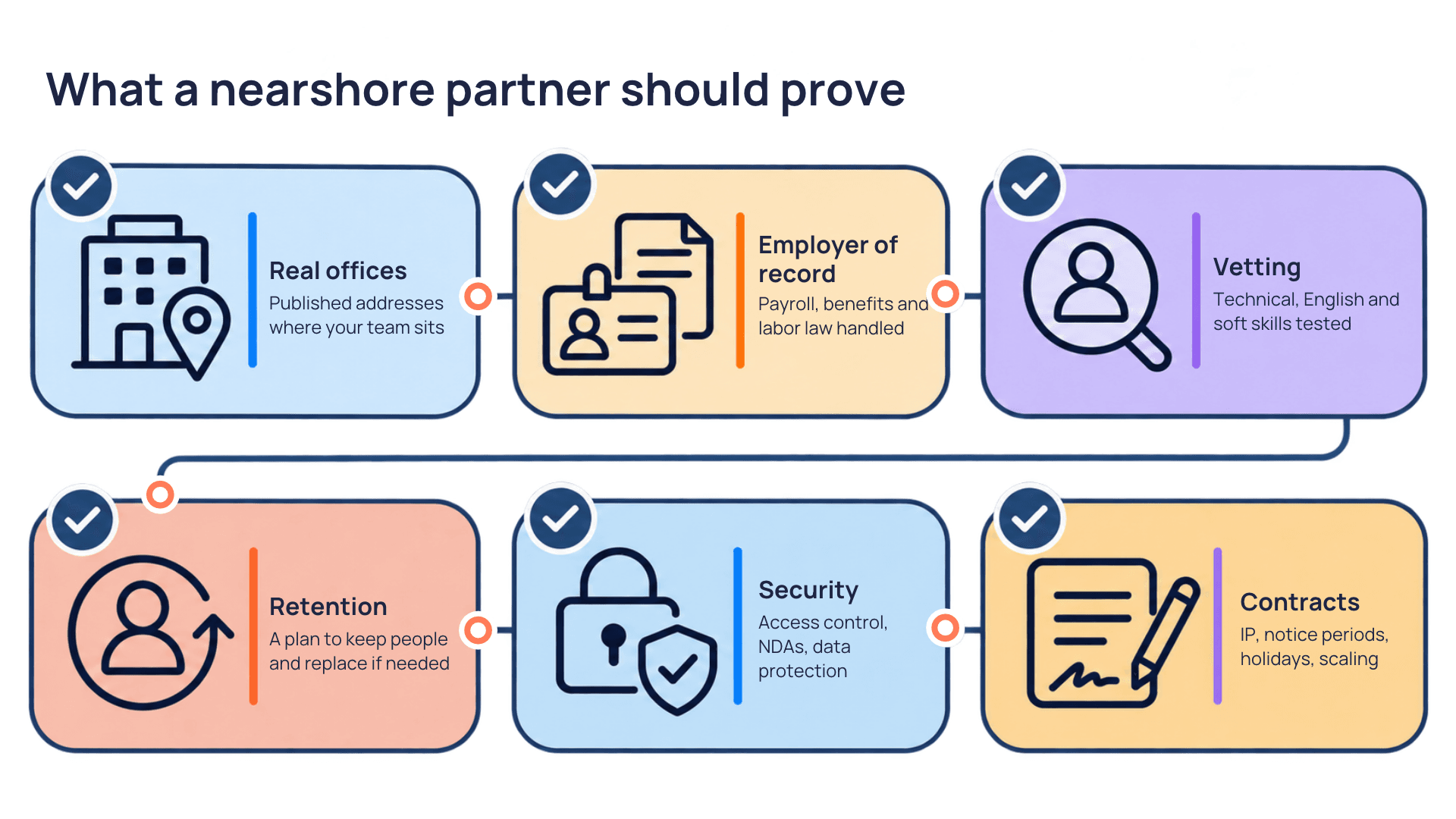
A nearshore partner is responsible for the people you work with every day, so ask for proof, not promises. Before you sign, check these six points:
- Real offices. Published addresses in the countries where your team will sit, not only a website and a phone number.
- Employer of record. The partner employs the engineers locally and handles payroll, benefits, taxes and labor law, so you do not have to set up a local entity.
- Vetting. A clear process that tests technical skills, English and soft skills before anyone joins your team.
- Retention. A plan to keep people engaged, plus a defined process if someone needs to be replaced.
- Security. Controlled access to your systems, secure devices, signed confidentiality agreements and data protection practices you can review.
- Contracts. Clear terms on intellectual property, notice periods, holidays and how to scale the team up or down.
Where Talentus Global works, and what that means for your team
Talentus Global is a US company headquartered in North Miami, Florida, with delivery centers in Mexico City, Bogotá, Lima and Buenos Aires, plus an office in Madrid. You can see every address on the page with Talentus Global's locations.
For your team, that means engineers who work your hours, bilingual professionals in English and Spanish, and a leadership team with more than 30 years of experience in technology services and more than two decades in higher education and EdTech. Bilingual teams also matter for US universities that serve Hispanic students.
Talentus Global offers four engagement models:
- Smart Sourcing: nearshore staff augmentation, with Talentus Global as employer of record, so you do not handle visas, payroll, benefits or office costs.
- Dedicated Teams: a full team with the roles your product needs.
- Software Outsourcing: a project delivered end to end.
- Managed IT Services: ongoing support for your existing systems.
Not sure which model fits? Read staff augmentation vs managed teams. To compare costs for your own roles, see how to calculate nearshore ROI or try the Nearshore Calculator.
FAQ
What is the difference between nearshoring and offshoring?
Nearshoring means working with a team in a nearby country with a small time difference, such as Latin America for US companies. Offshoring means working with a team far away, often 9 to 12 hours apart. Nearshore teams share most of your workday, which makes real-time collaboration much easier.
Is nearshore software development more expensive than offshore?
Yes, nearshore rates are usually higher than offshore rates. In return, you get a shared workday, faster feedback and fewer hand-offs. For product work that changes often, that speed can matter more than the hourly rate. Compare total cost and delivery time, not only the rate card.
What are the best countries for nearshoring to Latin America?
Mexico, Colombia, Argentina, Peru, Costa Rica and Brazil are the most common choices for US teams. Each has different strengths in talent, English level and time zone. The best country depends on the roles you need, the language level required and how many hours of overlap your team expects.
How do I choose a nearshore partner?
Ask for proof on six points: real offices, employer of record services, a clear vetting process, a retention plan, security practices and clear contracts. Talk to their engineers before you sign, and ask how they handle holidays, replacements and scaling the team up or down.
Next step
Every team is different. Schedule a consultation to find out which nearshore model and location fit your team.