
Blog
Insights & Articles
Explore the latest trends, strategies, and insights from the world of technology, talent, and digital transformation.
Designing Event-Driven Campus Architectures for Real-Time Data Flow
In today’s digital campus, speed is no longer just a technical convenience, it is directly tied to student success and operational stability.
The Human Orchestrator: Safeguarding Multi-Agent AI Networks in Engineering
The software engineering landscape is shifting rapidly from single prompt-and-response AI assistants to multi-agent AI networks. In these agentic workflows, autonomous software agents collaborate to write code, execute unit tests, refactor legacy schemas, and attempt automated deployments at machine speed.
LMS-to-ERP Synchronization: Eliminating Manual CSV Exports in University Financials
Every semester during the drop/add period, a familiar operational crisis plays out inside university finance departments.
The Death of Custom Scripts: Why Middleware Modernization Is Non-Negotiable
Ask any veteran IT director or CTO to show you their enterprise architecture diagram, and you will usually see a clean, polished layout of core systems: CRM, ERP, SIS, and analytics databases. Ask them what actually connects those systems, however, and the clean diagram dissolves into a maze of custom Python scripts, legacy Cron jobs, direct SQL triggers, and unmaintained point-to-point API adapters.
Solving the Integration Bottleneck: Introducing EdTech Connectors for LMS, SIS, CRM & ERP
In modern higher education IT, data silos are the silent killer of institutional agility. On any given campus, dozens of specialized enterprise platforms power daily operations. The admissions team lives in a CRM like Slate or Salesforce; faculty and students interact daily within a Learning Management System (LMS) like Canvas or Blackboard; the registrar relies on a legacy Student Information System (SIS) like Banner or PeopleSoft; and the finance department manages tuition through an ERP.

The July Retrospective: Shifting from Feed Saturation to High-Intent Conversion
As marketing teams pull their mid-year performance reports, a familiar pattern often emerges in the July retrospective: high impression numbers, expanding reach, and active social feeds, but flatlining pipeline growth.
Refactoring Technical Debt While Keeping Your Current Roadmap Alive
Ask any CTO or VP of Engineering about their biggest operational headache, and you will likely hear the same tug-of-war story. On one side, executive stakeholders and product leaders are pushing for new features to drive revenue and user engagement. On the other side, engineering leads are warning that the codebase is becoming a house of cards, held together by quick fixes, outdated dependencies, and fragile integrations.
Automated QA Systems: The Secret Weapon for Continuous Safe Deployment
In university IT departments, deployment day is often met with a collective sense of dread. Pushing an update to the Learning Management System (LMS) or rolling out a new feature in the admissions portal usually means crossing your fingers and hoping a critical integration doesn't break in the process.
Migrating to Cloud-Native: Mitigating Risks in Monolithic Refactoring
Every semester, university IT departments brace for the same inevitable crisis: registration week. As thousands of students simultaneously log in to secure their classes, the legacy Student Information System (SIS) groans under the weight of the traffic. Servers lag, portals crash, and the helpdesk is flooded with panicked tickets.
Eliminating "Break-Fix" IT Culture in Mid-Market Higher Education
In mid-market higher education, the IT department is often treated like a digital fire department. Instead of driving strategic technological innovation, internal teams spend their days reacting to crises: an API connection between the admissions CRM and the Student Information System (SIS) suddenly drops, a dorm Wi-Fi router fails during finals week, or a forgotten SSL certificate expires and takes down the student portal.
Campus AI-Readiness: Embedding Cognitive Assistants into Native Workflows
For the past two years, higher education's approach to artificial intelligence has largely been experimental. Universities rushed to deploy standalone, generic AI chatbots on their main website homepages to answer basic admissions questions.
Securing Student Data: Implementing Zero-Trust Architectures in EdTech
Universities are currently facing a cybersecurity crisis. With vast repositories of highly sensitive data, from financial aid records and social security numbers to proprietary research, higher education institutions have become prime targets for ransomware and data breaches.
The Integrated Campus: Connecting Disparate LMS and CRM Silos
Modern university students are digital natives who expect seamless, consumer-grade digital experiences. Yet, behind the scenes, higher education infrastructure is often a fragmented web of disconnected software systems.
Architectural Resilience: Preparing Your SIS for Peak Enrollment Surges
For university IT departments, enrollment week is the ultimate stress test. Over a 48-hour window, Student Information Systems (SIS) experience traffic spikes that can exceed normal operational loads by 1,000%.
Assembling a High-Velocity Engineering Pod Without Hiring Friction
For software executives and product leaders, scaling an engineering department often feels like trying to change a tire while driving down the highway. The engineering backlog never stops growing, customer feature requests continue to pile up, and critical system modernization tasks loom in the background.
Slicing Tech Debt in Half: A Calculator Case Study for CTOs
For enterprise CTOs, technical debt is not just an architectural nuisance, it is a continuous, compounding tax on product velocity and engineering budgets. When software developers spend up to 40% of their time refactoring legacy code, fixing recurring production bugs, or working around fragile API integrations, your organization’s innovation engine grinds to a halt.
Beyond the Hourly Rate: Calculating the Lifecycle Value of 95% Retention
When evaluating external software engineering partners, technology leaders are frequently drawn to the most obvious metric on a proposal: the hourly billing rate. In a spreadsheet comparison, selecting a vendor offering a lower unit cost appears to be an immediate win for the departmental bottom line.
Speed-to-Market: How to Onboard a Senior Developer in Under 48 Hours
In modern software product engineering, timing is everything. Whether you are racing to ship an AI-driven feature before a competitor, scaling an infrastructure stack ahead of a high-volume enrollment surge, or filling a critical engineering void left by sudden turnover, traditional recruitment timelines are your biggest liability.
The True Cost of Technical Latency: An Executive Budget Audit
For technology executives evaluating external sourcing models, the lowest hourly rate has historically been the primary metric for decision-making. If an offshore engineering team on the other side of the globe offers a senior developer for significantly less than local talent, the financial calculation seems straightforward.
Unlocking Enterprise Value with Autonomous Workflow Agents
The enterprise artificial intelligence landscape has undergone a massive paradigm shift. Over the past few years, the primary focus was on conversational AI, deploying generative chatbots to draft emails, answer basic customer service queries, or summarize internal documents. While valuable, these tools remained passive assistants reliant on constant, manual human prompts.
Why Generative AI Prototypes Stall at the Integration Layer
Across boardrooms and IT departments, the enthusiasm surrounding Generative AI remains at an all-time high. Executive leadership envision autonomous agents handling complex workflows, real-time predictive analytics guiding business decisions, and automated customer experiences operating without a hitch. Teams quickly spin up impressive Proofs of Concept (PoCs) a localized LLM connected to a sample document repository, or a slick chatbot interface demonstrating basic reasoning capabilities.
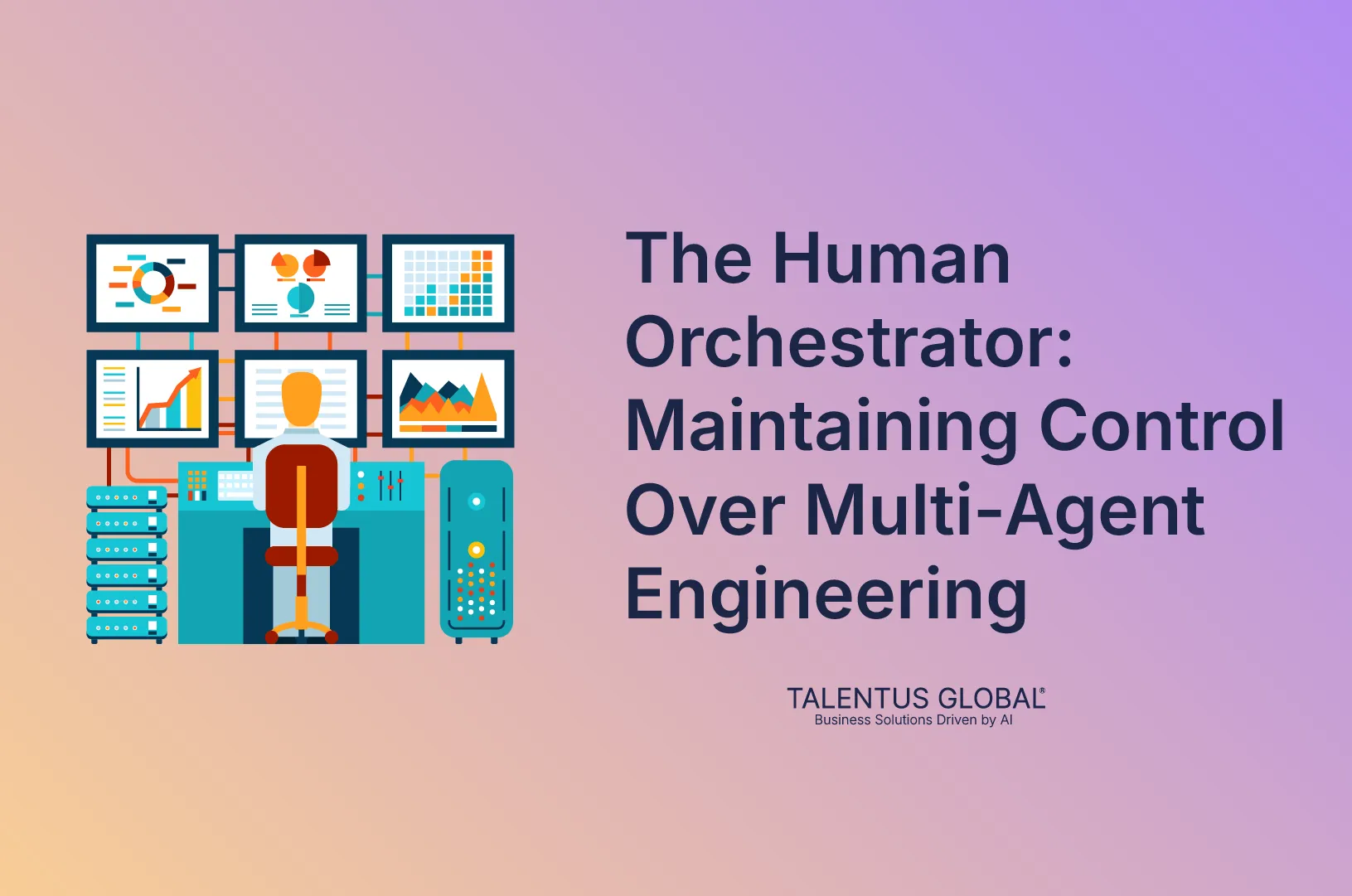
The Human Orchestrator: Maintaining Control Over Multi-Agent Engineering
As enterprise engineering teams scale their artificial intelligence implementations, the architectural pattern has fundamentally shifted. The industry has moved rapidly past single-prompt chatbots toward complex, multi-agent AI networks. In these advanced environments, specialized autonomous agents collaborate with each other, one writing code, another generating automated QA test scripts, a third optimizing server allocation, and a fourth managing continuous deployment pipelines.
The Roadmap to AI-Readiness: Preparing Your Integration Layer Today
When technology leaders map out their transition toward Artificial Intelligence, the immediate instinct is to look at the models themselves. Teams spend weeks debating the merits of various Large Language Models (LLMs), evaluating open-source frameworks, or prototyping localized chatbots. But here is the reality facing enterprise engineering teams: your AI strategy is only as fast as your integration layer.
AI Guardrails: Why Strategy & Governance Consulting Is Essential for Responsible AI
Artificial Intelligence is rapidly becoming a competitive advantage across industries. From automating customer support to accelerating software development and improving business intelligence, AI is transforming how organizations operate. However, as AI adoption grows, so do the risks associated with security, compliance, bias, data privacy, and governance.
Request a Consultation
We deliver and build unique teams and solutions that help your business grow.